I still remember the first time I held a Pokémon card and thought, huh, this feels important somehow. Not “important” like taxes or house keys, but important like a childhood memory you don’t know is forming yet.
The card was a little scuffed, corners soft like they’d been chewed by time itself, and yet it fit my hand perfectly, as if the world had agreed on this size long before I was born.
That quiet agreement is what this whole guide is about. Pokémon Card Dimensions aren’t just measurements on a ruler, they’re part of a global promise that whether you opened a pack in 1996 or last Tuesday,
the cards would feel right, shuffle right, and live together in binders without fighting each other for space. This guide is me unpacking that promise, slowly, with facts, stories, and a few “wait, really?” moments along the way.
| Item | Dimensions / Specs |
|---|---|
| Standard Pokémon card size | 2.5 × 3.5 in (63.5 × 88.9 mm) |
| Aspect ratio | 5:7 |
| Card thickness | ~0.012 in (0.305 mm) |
| Corner radius | ~0.125 in (3.18 mm) |
| Card weight | ~1.78 g |
| Oversized Pokémon cards | 5 × 7 in |
| Sleeve size | 2.64 × 3.58 in (67 × 91 mm) |
| Toploader size | 3 × 4 in (76 × 101 mm) |
| Standard trading card size compatibility | Same as Magic: The Gathering |
| Yu-Gi-Oh! card size (comparison) | Smaller than Pokémon cards |
The Standard Pokémon Card Dimensions Everyone Knows (Even If They Don’t)
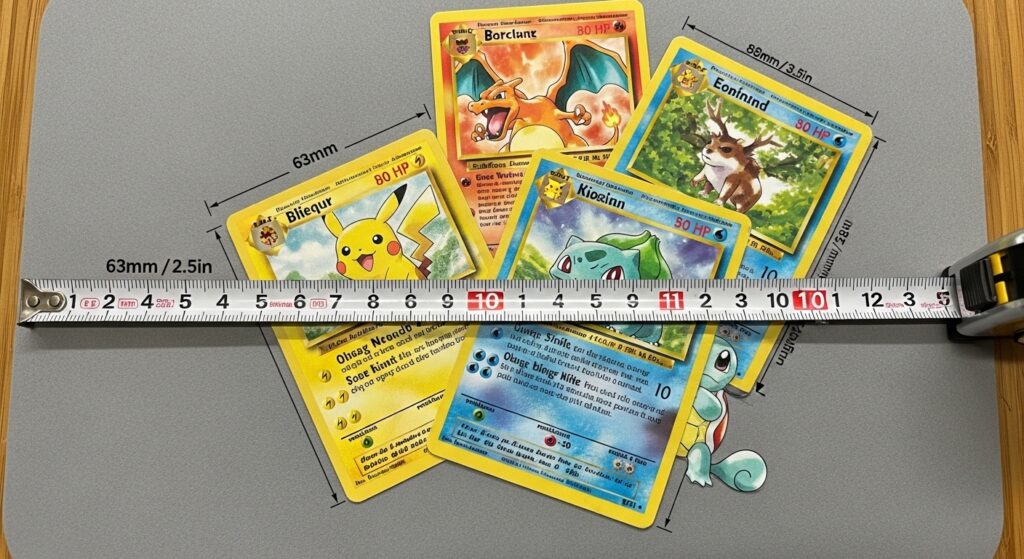
Let’s start with the thing everyone thinks they know but rarely actually measures. Standard Pokémon cards follow the classic trading card size: 2.5 × 3.5 inches, which in the more metric-friendly corners of the world becomes 63.5 × 88.9 mm.
This size didn’t just fall from the sky, it was chosen because it worked. It worked for shuffling, for printing, for storage, and for hands both big and small, including those slightly sticky ones that belong to kids who just opened a booster pack five seconds ago.
The aspect ratio sits neatly at 5:7, which sounds boring until you realize how much visual balance depends on it. Art boxes, text areas, attack descriptions, all of it breathes comfortably in that frame.
The card thickness, roughly 0.012 inches (0.305 mm), is another quiet hero. Thick enough to feel real, thin enough to shuffle a 60-card deck without feeling like you’re wrestling cardboard pancakes.
A standard Pokémon card weighs about 1.78 grams, which is such a specific number it feels made up, but it’s not. Collectors even use card weight sometimes to help spot counterfeit Pokémon cards, because fakes often feel just a little… off, like a handshake that lingers too long.
Pokémon Card Dimensions and the Birth of Global Consistency
Back in 1996, when Pokémon was still stretching its legs, nobody could’ve guessed that over 34 billion cards sold later, people would still care deeply about millimeters.
The Pokémon Trading Card Game (TCG) launched with a commitment to standardized card size, similar to what Magic: The Gathering had already established.
That decision made tournaments possible, but more importantly, it made trading fair. No one wants to trade a cool card only to realize later it doesn’t fit their binder pockets, which is a uniquely modern kind of heartbreak.
The original Base Set, home of legends like the Holographic Charizard (Base Set), followed these same dimensions. That’s part of why a card from the 90s can sit peacefully next to a modern pull without anyone noticing the age gap. A collector once said, “The size never changed, only the stories did,” and honestly that feels about right.
When Pokémon Card Dimensions Go Big: Oversized Cards Explained
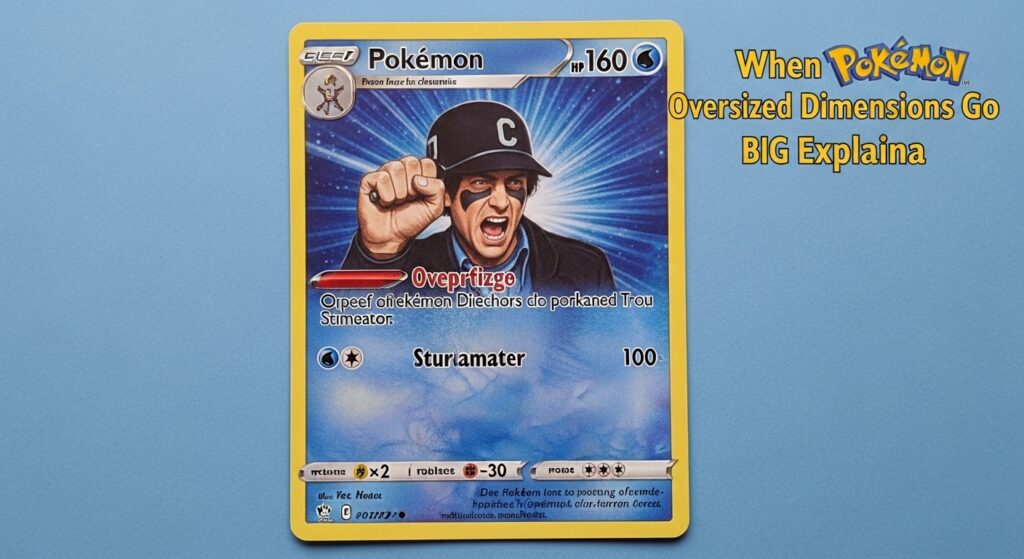
Every now and then, Pokémon breaks its own rules, but in a fun way. Oversized Pokémon cards usually measure around 5 × 7 inches, and they’re not meant for gameplay at all.
These cards are for display, for joy, for that feeling of “wow this is ridiculous and I love it.” You’ll often find them in a Special Collection Box, leaning dramatically against the regular-sized cards like an older sibling who grew up faster.
Oversized cards keep the same 5:7 aspect ratio, just scaled up, which means the art doesn’t look stretched or weird. Still, storing them is its own adventure.
Regular binders won’t cut it, and standard Pokémon card sleeves will laugh at you if you try. People often store these flat, in cool, dry storage, sometimes with custom frames, because bending an oversized card feels morally wrong somehow.
Pokémon Card Dimensions in mm, Inches, and Collector Reality
Collectors love specifics, and Pokémon happily provides them. The rounded corners of a Pokémon card have a corner radius of about 0.125 inches (3.18 mm), which might sound trivial until you’ve held a card with sharp corners.
Rounded corners reduce wear, help with shuffling, and make sleeves last longer, which is something your future self will quietly thank you for.
The cardstock itself is flexible but not flimsy, designed to survive years of play. Flexibility is part of gameplay balance, because a card that creases easily becomes marked, and marked cards ruin tournaments faster than a spilled soda on a playmat.
Pokémon Card Dimensions and Storage: Sleeves, Toploaders, and Binders
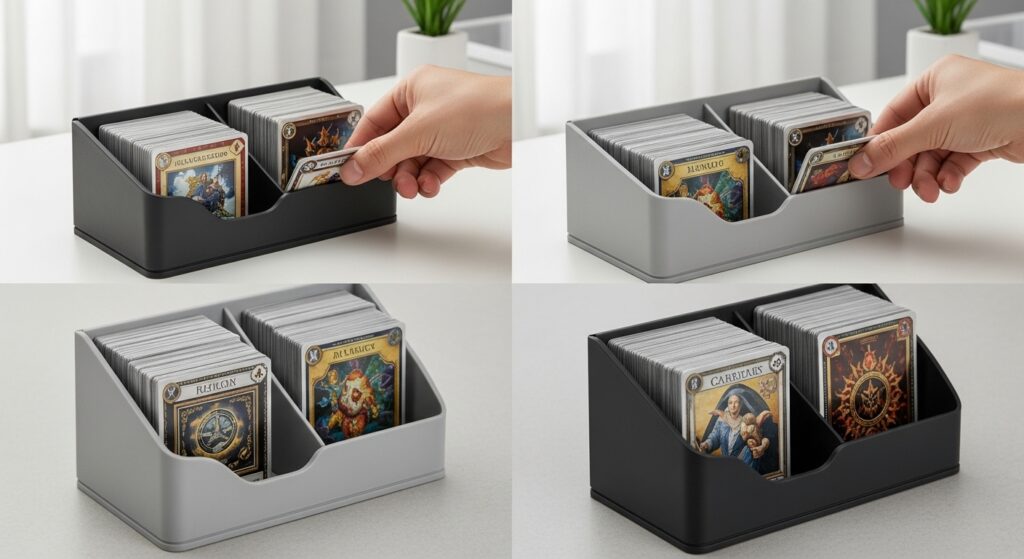
If you’ve ever bought sleeves that didn’t fit, you know the special irritation that follows. Standard sleeve size for Pokémon cards is 2.64 × 3.58 inches (67 × 91 mm).
That tiny bit of extra space allows the card to slide in without catching, while still offering dust resistance, moisture protection, and a bit of UV protection depending on the material.
Most sleeves are made from polyethylene sleeves or polypropylene sleeves, both of which are safe for long-term storage. For higher value cards, like that Charizard you refuse to admit you own, toploaders measuring 3 × 4 inches (76 × 101 mm) add rigid anti-bending protection.
Then there are binder pockets, usually designed for standard trading card size, which is why Pokémon fits so comfortably next to sports cards in some collections, even if they don’t socially mix.
Decks live in deck boxes, and a standard box is built to hold 60 sleeved cards, sometimes more if the box is feeling generous. This is where Pokémon card dimensions quietly shape daily habits, from deck building to travel to local meetups.
Pokémon Card Dimensions Compared to Other Trading Card Games
Here’s where things get interesting. Pokémon shares its size with Magic: The Gathering, which makes cross-compatible storage easy. You can use the same binders, the same sleeves, the same boxes, and no one gets mad.
Yu-Gi-Oh!, however, chose chaos, or at least smaller cards. Yu-Gi-Oh card dimensions are noticeably smaller, which means Pokémon cards look like gentle giants next to them.
In a trading card size comparison, Pokémon sits comfortably in the “standard” category, alongside most sports cards. This standardization helps the broader trading card market growth, because accessories don’t need to reinvent themselves for every game. It’s boring in the best possible way.
Pokémon Card Dimensions Inside Booster Packs and Boxes
A standard booster pack weighs around 22–24 grams, though collectors obsess over heavy booster packs (24–25 g) and light booster packs (22–23 g), hoping weight might hint at rare pulls.
While modern packs don’t guarantee anything based on weight, the myth refuses to die, and honestly that’s part of the fun.
An Elite Trainer Box (ETB) usually weighs between 280–300 grams, packed with sleeves, dice, and booster packs that all rely on consistent card sizing.
Theme Decks or Battle Decks land around 190–210 grams, while a Special Collection Box can weigh anywhere from 500–800 grams, depending on how much joy they stuffed inside.
Pokémon Card Dimensions and Gameplay Balance
Dimensions affect gameplay more than people realize. Shuffling, drawing, even how cards fan in your hand, all depend on size and thickness. In competitive tournaments, consistency is king. If one card were even slightly larger, it could be identified from the deck, which breaks the game.
Different Pokémon card types all share the same dimensions:
- Basic Pokémon
- Evolution Pokémon
- Trainer cards, including Item cards, Supporter cards, and Stadium cards
- Energy cards, from Fire Energy to Psychic Energy and Special Energy
This uniformity keeps deck building fair and strategy-focused, rather than physically biased.
Pokémon Card Dimensions, Value, and the Collector’s Eye
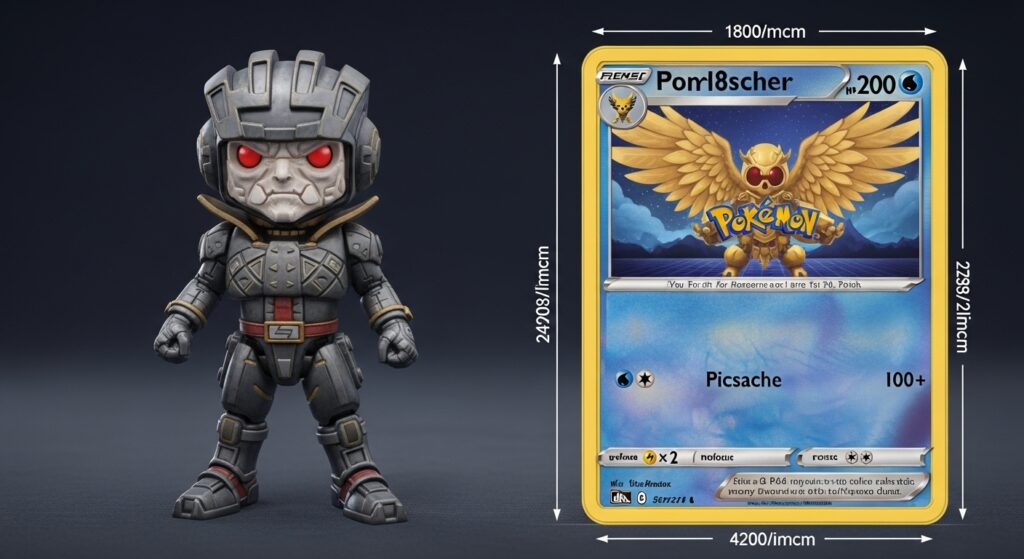
Value often lives in condition, and condition lives in protection. A card stored flat, in a sleeve, inside a toploader, in a cool, dry place, has a better chance of aging gracefully. That’s why card protection isn’t just paranoia, it’s practical.
When a Holographic Charizard (Base Set) sells at auction for $300,000+, people suddenly care a lot about anti-creasing and UV protection. Dimensions matter because they dictate which storage solutions actually work, and which quietly damage your collection over time.
The Cultural Weight of a Simple Rectangle
Pokémon cards are a cultural phenomenon, not because of their size, but because that size never got in the way. Kids trade them at school, adults trade them online, and collectors display them like tiny art prints.
In Japan, cards are sometimes gifted as good-luck charms to young players starting tournaments. In the US, parents tell stories about finding old binders in closets, rediscovering childhood in neat plastic pages.
One long-time collector once told me, “The card didn’t change shape, but I did,” which feels like something only a trading card game could inspire.
Practical Advice: How to Respect Pokémon Card Dimensions in Real Life
If you want to do right by your cards, start simple. Buy the correct Pokémon card sleeves, double-sleeve valuable pulls, and don’t overstuff binders. Keep cards flat, away from heat, and don’t test gravity by stacking them in weird ways. When traveling to tournaments or local meetups, a sturdy deck box is your friend, not an optional accessory.
And if you’re gifting cards, presentation matters. A clean sleeve and a simple note can turn a common pull into a memory someone keeps for years, which is kind of magical when you think about it.
read this Blog: https://marketmetl.com/how-long-is-5-inches/
Frequently Asked Questions
What are the standard Pokémon card dimensions?
Standard Pokémon Card Dimensions are 2.5 × 3.5 inches (63.5 × 88.9 mm), matching the classic trading card size used worldwide.
Are Pokémon cards the same size as Magic: The Gathering cards?
Yes, Pokémon cards share the same dimensions as Magic: The Gathering, making sleeves, binders, and deck boxes interchangeable.
Do oversized Pokémon cards have different dimensions?
They do, oversized Pokémon cards usually measure about 5 × 7 inches and are made for display, not gameplay.
How thick is a Pokémon card?
A standard Pokémon card is around 0.012 inches (0.305 mm) thick, sturdy enough for shuffling without feeling stiff.
Why are Pokémon card dimensions important for collectors?
Consistent dimensions help with proper storage, fair gameplay, and long-term protection using standard sleeves and binders.
Closing Thoughts on Pokémon Card Dimensions
In the end, Pokémon Card Dimensions are a quiet success story. They’ve stayed consistent through decades, through changing art styles, evolving strategies, and a fanbase that grew up without ever really leaving. These cards are small rectangles of cardboard, yes, but they’re also vessels for nostalgia, competition, and connection.
If you’ve got a favorite card, or a story about your first pack, share it. Talk about the one that got away, or the one you still protect like it’s made of glass. Because somewhere between 2.5 × 3.5 inches and a lifetime of memories, Pokémon figured out something special, and we’re all still holding it in our hands.