There was a day, not long ago, when I stood in a dusty schoolyard watching a kid measure the running track with his footsteps, swearing it was “about a hundred… something.”
He looked at me like numbers were feelings, not facts. And in a way, they kinda are. Length measurement sneaks into our lives quietly, measuring gardens, races, fabrics, rooms, even dreams sometimes.
Somewhere between a meter and a yard, people get confused, curious, and occasionally very sure they’re right when they’re not.
This piece is for those moments. Not stiff, not robotic, but human, a bit crooked round the edges, like real measuring tapes that never quite roll back straight.
We’re talking about meters to yards conversion, yes, but also about why it matters, how it works, and how to make peace with numbers that live in two worlds at once: the Metric system and the Imperial system. Grab a coffee, or don’t, but let’s walk this distance together.
Meter to Yards Conversion Table
| Meters (m) | Yards (yd) |
|---|---|
| 1 | 1.0936 |
| 5 | 5.468 |
| 10 | 10.936 |
| 25 | 27.34 |
| 50 | 54.68 |
| 100 | 109.36 |
| 250 | 273.4 |
| 500 | 546.8 |
| 1000 | 1093.6 |
Understanding Length Measurement in Everyday Life
Length is one of those things we think we understand until someone asks, “how long exactly?” Suddenly we’re waving hands in the air.
Measurement units exist so we don’t have to argue forever. A standardized unit of measurement keeps us honest, or at least trying to be.
In most of the world, people grow up with meters. It’s part of the International System of Units (SI), even if nobody says the full name out loud at dinner.
In the US though, the US customary system holds tight to yards, feet, and inches like family heirlooms. Neither is wrong, they just speak different dialects of distance.
A grandmother once told me, “I still picture a yard as the length of my old kitchen table,” and honestly, that’s how measurement really works. It’s memory mixed with math.
Meter to Yard Conversion: Definition That Actually Makes Sense
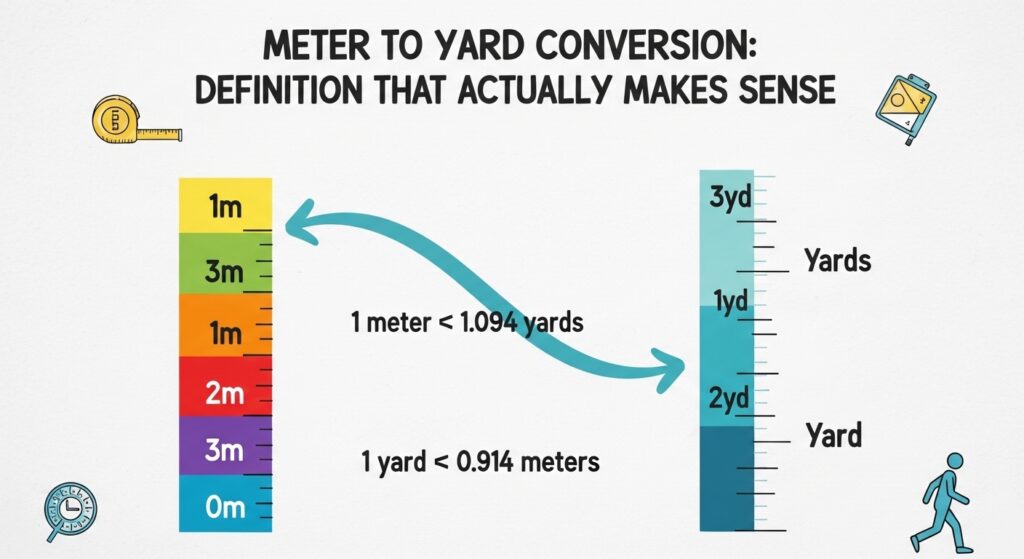
So what does it mean to convert a meter to a yard. At its core, unit conversion is about unit equivalence, finding peace between two ways of saying the same thing. A meter is slightly longer than a yard, which surprises some folks every single time.
The official, no-arguing numbers go like this
1 meter = 1.0936 yards
1 yard = 0.9144 meters
These aren’t vibes or estimates, they’re fixed, locked-in values used for conversion accuracy across science, sports, construction, and those annoying math worksheets kids bring home.
Conversion isn’t betrayal. You’re not switching sides. You’re just translating distance into another accent.
The Conversion Formula Explained Without the Headache
Here’s where people expect it to get scary, but it really doesn’t. The conversion formula is almost friendly, if you squint a bit.
To go from meters to yards
Yards = meters × 1.0936
To go the other way
Meters = yards × 0.9144
That’s it. That’s the whole secret. No hidden steps, no magic symbols. This mathematical formula shows up in math learning tools, practice math problems, and even fancy calculators labeled meter to yard calculator, which feels a bit dramatic for one multiplication, but okay.
A teacher once joked, “If you can multiply, you can travel internationally,” and she wasn’t wrong.
Worked Examples That Feel Like Real Life
Let’s not float in theory too long. Numbers like to be used. These are worked examples, the kind you’ll see in solved math tasks or educational math content, but with a little air in them.
• 100 meters = 109.36 yards
You multiply 100 by 1.0936, and there it is. Suddenly a sprint looks longer.
• 1500 meters = 1640.4 yards
That’s a classic track distance, and runners switching systems always pause here, doing mental math mid-jog.
• 1500 yards = 1371.6 meters
Same distance-ish, different lens. It’s a good reminder that numbers depend on perspective.
These are not just numbers on paper. They’re races, walks, fences, and stories measured carefully.
Read this Blog: https://marketmetl.com/x-squared/
Conversion Table for Quick Reference (Meters to Yards)
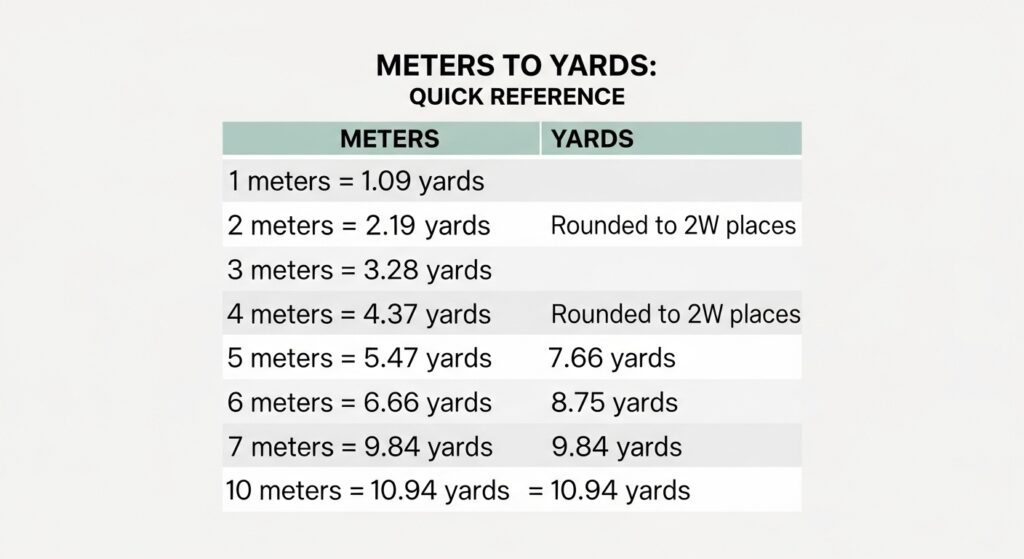
Sometimes you don’t wanna calculate. You just wanna look. A conversion table is like a quiet friend who already did the math.
• 1 meter = 1.0936 yards
• 5 meters = 5.468 yards
• 10 meters = 10.936 yards
• 50 meters = 54.68 yards
• 100 meters = 109.36 yards
• 500 meters = 546.8 yards
• 1000 meters = 1093.6 yards
This kind of unit conversion table shows up in textbooks, on workshop walls, and inside toolkits. It’s not flashy, but it works.
Yards to Meters Conversion and Why It Still Matters
Even if this article leans meter-first, the yards to meters conversion deserves respect. Plenty of distance conversion problems start with yards, especially in American sports fields or older blueprints.
Using
Meters = yards × 0.9144
You can solve a lot of real-world measurement problems without breaking a sweat. It’s especially useful when dealing with perimeter of a field or the radius of a circular track, where switching units halfway can mess everything up in quiet, evil ways.
A civil engineer once said, “Most mistakes aren’t big, they’re just the wrong unit,” and that line stuck hard.
Meters vs Yards: Which Is Longer, Really
This question comes up more than you’d think. Which is longer meter or yard feels like a trick, but it’s not.
A meter is longer. Just a bit, but enough to matter. About 9.36 centimeters longer, if you wanna get specific. This difference matters in measurement comparison, especially when scaling up to big distances.
In rectangular shape layouts, like rooms or fields, mixing up meters and yards can throw off area calculations fast. One wrong assumption, and suddenly your furniture doesn’t fit, ask me how I know.
Geometry, Distance, and Sneaky Conversions
Conversions don’t live alone. They sneak into geometry problems, like calculating the perimeter of a yard (the place or the unit, fun confusion there) or the circumference of a wheel rolling down a road, quietly counting rounds.
If a wheel has a radius measured in meters, but the road distance is in yards, you either convert or cry. Most choose convert.
These moments are why measurement practice exists, why teachers insist on showing units in every answer. Units tell the story, not just the number.
Practice Questions to Make It Stick
Learning sticks better when your brain does the lifting. These practice questions mirror what you’ll see in math quizzes or conversion worksheets, but with less pressure.
• Convert 25 meters into yards
• How many meters are in 300 yards
• A garden is 40 meters long, what is that in yards
• Compare 60 yards and 55 meters, which is longer
These are math conversion problems that train intuition. Over time, you start guessing right before calculating, which feels like a superpower, not gonna lie.
Learning Tools and Educational Support
Today’s learners have options. From online platforms like Brighterly to classic educational worksheets, math education has gone digital and interactive. Online learning tools now turn solved examples into games, and practice tests into confidence boosters.
Middle school teachers often say conversions are where students first learn that math is practical. It’s not just numbers, it’s knowing how far, how long, how big. Elementary math builds the base, but conversions give it legs.
Cultural Notes on Measurement Systems
In the UK, yards and meters live side by side like slightly awkward cousins. Road signs might be in miles, but track events run in meters. This mix creates a natural fluency in metric vs imperial units that other places don’t always have.
A retired PE coach once said, “I think in yards, but I teach in meters,” which sums up the cultural dance perfectly. Measurement systems carry history, not just math.
Common Mistakes People Make (So You Don’t)
Even smart people trip here. Especially smart people, sometimes.
• Forgetting to convert before solving
• Using the wrong conversion rate
• Mixing units in one equation
• Rounding too early with decimal values
Awareness fixes most of these. Slow down, check units, breathe. Math isn’t chasing you.
How to Write Your Own Conversion Notes
If you’re studying, make it personal. Write conversions in your own words. Draw a little table. Note which unit is longer. This turns abstract rules into memory anchors.
Teachers recommend keeping a mini length conversion chart in notebooks. It’s low-tech, high reward.
Creative Ways to Practice and Remember
Say the formulas out loud. Tape a conversion table near your desk. Measure random objects at home and convert them for fun, or procrastination, same thing sometimes.
Parents helping kids with homework often say the best learning happens mid-conversation, not mid-lecture. Make conversions casual.
Frequently asked Questions
meter ke yard
To convert meters to yards, multiply the meter value by 1.0936.
This helps change metric measurements into US customary units.
1500 yard berapa meter
1500 yards = 1371.6 meters.
You can find this by multiplying yards by 0.9144.
m ke yard
Meters to yards conversion is done using the formula:
yards = meters × 1.0936.
20 yard berapa meter
20 yards = 18.288 meters.
This is calculated by multiplying 20 by 0.9144.
1 meter berapa yard
1 meter = 1.0936 yards.
This shows that a meter is slightly longer than a yard.
A Thoughtful Wrap-Up on Distance and Understanding
Distance isn’t just space between points. It’s understanding between systems, between people taught differently. When you learn meters to yards conversion, you’re not just learning math, you’re learning translation. Between worlds, habits, histories.
So next time someone asks how many yards are in a meter, or squints at a field unsure of its size, you’ll know. And maybe you’ll smile, remembering that kid counting footsteps, trusting feelings over facts, until facts finally felt friendly.
If you’ve got a favorite trick for remembering conversions, or a story about getting them hilariously wrong, share it. Measurement is serious, sure, but learning it doesn’t have to be stiff. Distance, after all, is meant to be crossed.