There’s something oddly satisfying about comparing two things and realizing how far apart they really are. Not emotionally though that happens too but numerically. I remember sitting at a small wooden desk years ago, helping a younger cousin with math homework.
The question looked simple: compare two numbers. Yet somewhere between confusion and curiosity, we stumbled into the world of percentages, and suddenly numbers started telling stories.
That’s really what Percent Difference is about. It’s not just a dry Mathematical Calculation scribbled in a notebook.
It’s a way to measure the Relationship Between Values, to understand how two quantities drift apart or come closer together.
Whether you’re comparing exam scores, chocolate bar prices, or the heights of famous landmarks, this concept pops up everywhere.
If you’ve ever wondered how to calculate percent difference step by step, you’re in the right place. We’ll wander through the Definition, unpack the Percent Difference Formula, explore worked examples, and even play with a
few friendly practice questions. Along the way, expect some small detours stories, little mistakes, maybe even a chuckle or two.
Let’s begin.
| Concept | Explanation | Key Elements |
|---|---|---|
| Percent Difference | A comparative measurement used to find how much two values differ relative to their average of values. | Used in data analysis, relative measurement, and value comparison. |
| Definition | Percent Difference measures the relative variation between two numbers by comparing their absolute difference to their mean value. | Shows the relationship between values in percentage form. |
| Percent Difference Formula | The percentage difference formula calculates the difference between two values and divides it by their average. | ** |
| Absolute Difference | The positive difference between two numbers using the absolute value operation. | |a − b| |
| Average of Values | The average calculation of the two numbers being compared. | (a + b) ÷ 2 |
| Calculation Steps | Simple mathematical operations to find the percentage result. | 1. Find difference 2. Take absolute value 3. Find average 4. Divide 5. Multiply by 100 |
| Example | If a = 20 and b = 25 | Difference = 5, Average = 22.5 |
| Percent Difference Result | Final percentage calculation showing relative difference. | (5 ÷ 22.5) × 100 = 22.22% |
| Percent Difference vs Percentage Change | Percent Difference compares two values equally, while percentage change measures increase or decrease from an original value. | Used in comparative statistics and data interpretation. |
| Real-Life Uses | Helps compare measurements, prices, test scores, or scientific results. | Used in quantitative analysis, statistical measurement, and data comparison. |
Understanding the Definition of Percent Difference
Before diving into formulas, it helps to understand the meaning behind the numbers.
The Percent Difference describes how much two values differ from each other relative to their Average of Values.
Unlike Percentage Change, which compares a starting value to an ending value, this method treats both numbers equally. In other words, neither value is considered “the original.”
Mathematically speaking, it’s a Relative Measurement that highlights the Absolute Difference between two quantities.
Imagine two students comparing their grades. Maybe Molly scored 88 on a math test while Joan scored 92. Instead of simply subtracting the scores, percent difference helps us express that gap as a percentage of their average performance.
This concept lives right inside many Mathematical Concepts such as ratio calculation, percentage calculation, and quantitative analysis.
In fields like Data Analysis, science experiments, or even everyday shopping comparisons, this kind of comparative measurement becomes surprisingly useful.
Put simply:
Percent Difference shows how far apart two numbers are in percentage terms.
And honestly? Once you understand it, the whole thing feels less like math and more like translating numbers into a language humans can actually feel.
The Percent Difference Formula Explained
Alright, time for the part that looks intimidating but actually isn’t.
The Percent Difference Formula relies on three basic steps: finding the difference, calculating the average, and converting the result into a percentage.
The formula looks like this:
Percent Difference Formula2a+b∣a−b∣×100
Where:
- a and b are the two values being compared
- |a − b| represents the absolute value (ensuring the difference is positive)
- The denominator calculates the Average of Values
This formula uses several fundamental Mathematical Operations:
- Subtraction to find the difference between numbers
- Absolute value operation to ignore negative signs
- Division (÷) to compare difference with the average
- Multiplication (×) by 100 to convert the result into a percentage
Together these operations produce a Percentage Result that expresses the Relative Variation between two quantities.
It’s honestly kinda neat when you see it working.
Step-by-Step Guide: How to Calculate Percent Difference
Let’s slow things down and break the percent difference calculation steps into manageable pieces.
Step 1: Find the Difference Between Numbers
Start by subtracting the two values.
Example:
If a = 20 and b = 25
Difference = 20 − 25 = −5
Next apply the Absolute value symbol | |.
Absolute Difference = |−5| = 5
Step 2: Calculate the Average of the Values
Add the two numbers together and divide by two.
Average = (20 + 25) ÷ 2
Average = 45 ÷ 2
Average = 22.5
This is the mean value, an important idea in statistical measurement and data comparison.
Step 3: Divide the Difference by the Average
Relative difference = 5 ÷ 22.5
Relative difference ≈ 0.2222
Step 4: Convert to Percentage
Multiply by 100.
Percent Difference = 0.2222 × 100
Percent Difference ≈ 22.22%
And there you go. The difference between two numbers is about 22.22%.
Not too scary, right?
Percent Difference Examples from Real Life
Math gets easier when numbers come attached to stories. So let’s explore a few percent difference examples using everyday scenarios.
Chocolate Bar Comparison
Nick buys a chocolate bar that weighs 95 grams.
Zoey buys one that weighs 100 grams.
Difference = |95 − 100| = 5
Average = (95 + 100) ÷ 2 = 97.5
Percent Difference = (5 ÷ 97.5) × 100 ≈ 5.13%
So the chocolate bars differ by about 5.13% in weight.
Not huge, but maybe enough to make Zoey smile a little wider.
Comparing Famous Landmarks
Let’s compare two iconic structures.
Height of Washington Monument ≈ 169 meters
Height of Statue of Liberty ≈ 93 meters
Difference = |169 − 93| = 76
Average = (169 + 93) ÷ 2 = 131
Percent Difference = (76 ÷ 131) × 100 ≈ 58.02%
That’s quite a gap. The Washington Monument stands dramatically taller.
This is a nice illustration of comparative statistics and numerical relationships.
School GPA Example
Consider two students discussing grades.
John has a Grade Point Average (GPA) of 3.6
Noah has a GPA of 3.9
Difference = |3.6 − 3.9| = 0.3
Average = (3.6 + 3.9) ÷ 2 = 3.75
Percent Difference = (0.3 ÷ 3.75) × 100 ≈ 8%
So their academic performance differs by roughly 8 percent.
A small difference but in competitive schools, even that tiny gap matters.
Percent Difference vs Percent Change Explained
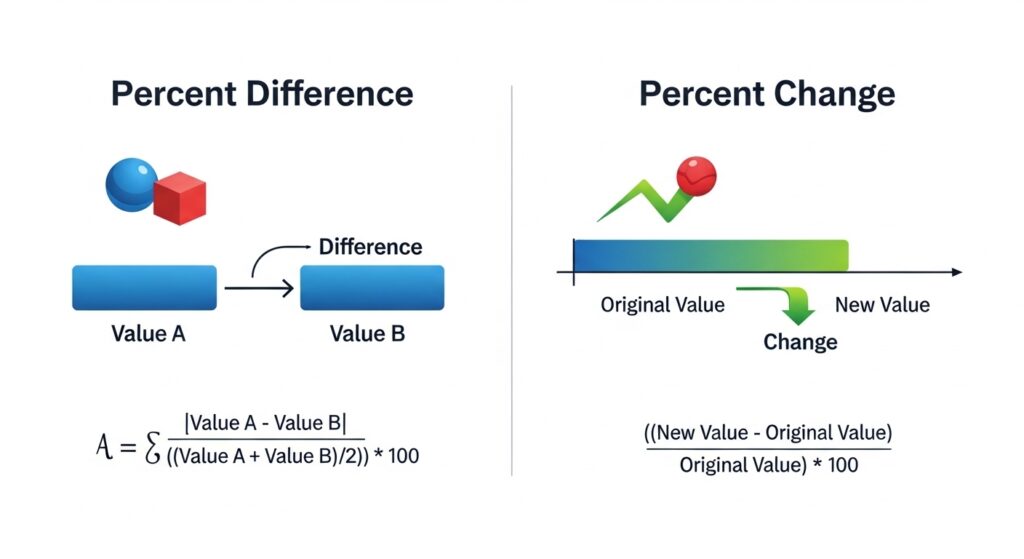
People often mix up Percent Difference and Percentage Change. And honestly… it’s easy to see why.
Both involve percentages and both compare numbers. But they answer different questions.
Percent Difference
Used when comparing two values with no clear starting point.
Example: comparing heights of landmarks or exam scores between two students.
This method focuses on Relative comparison using the Average of Values.
Percentage Change
Used when something changes over time from an initial value to a final value.
Example: price increase of a book from $20 to $25.
The Percentage Change Formula looks like:
(New Value − Original Value) ÷ Original Value × 100
This highlights increase vs decrease percentage rather than symmetrical comparison.
In short:
Percent Difference = comparison between two equal values.
Percent Change = growth or decline from an original value.
Subtle difference, but an important one.
Solved Percent Difference Math Problems
Here are a few solved percent difference problems to strengthen your understanding.
Example 1: Comparing Books
Molly bought a book for $18.
Joan bought the same title for $20 at another store.
Difference = |18 − 20| = 2
Average = (18 + 20) ÷ 2 = 19
Percent Difference = (2 ÷ 19) × 100 ≈ 10.53%
Example 2: Vase Prices
A decorative vase costs $45 in one shop and $50 in another.
Difference = 5
Average = 47.5
Percent Difference = (5 ÷ 47.5) × 100 ≈ 10.53%
Interesting coincidence it’s the same percentage as the book example.
Math sometimes repeats patterns in funny ways.
Example 3: Formal Dress Prices
A formal dress costs $120 in one boutique and $135 in another.
Difference = 15
Average = 127.5
Percent Difference = (15 ÷ 127.5) × 100 ≈ 11.76%
Suddenly those price differences feel more real.
Percent Difference Practice Questions
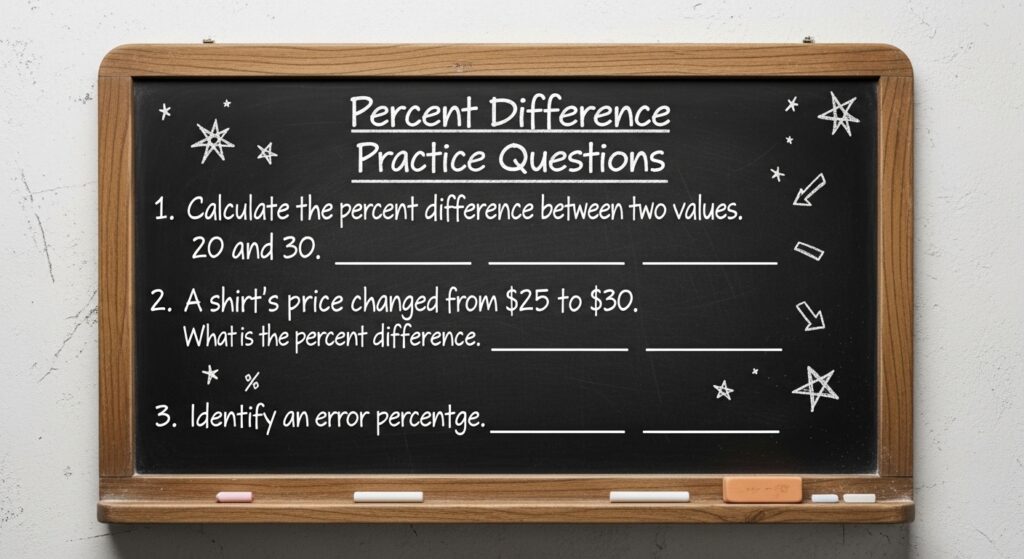
Ready to test your skills? These learning exercises are perfect for students practicing percentage math problems.
Try solving them before checking with a calculator.
• Two chocolate bars weigh 110 g and 100 g. Calculate the percent difference.
• A student’s science score is 78 while another student scores 84. What is the relative percent difference?
• Two school fundraiser totals are $450 and $500. Find the percentage difference.
• Compare the heights 150 cm and 165 cm.
• Compare two temperatures: 22°C and 25°C.
Teachers often turn problems like these into percent difference worksheets or math percentage exercises for classrooms.
They might look simple, but they train your brain in data interpretation, statistical measurement, and value comparison.
Why Percent Difference Matters in Data Analysis
Here’s the thing most math textbooks forget to mention: Percent Difference isn’t just classroom math.
Scientists use it to compare experimental results. Economists use it in comparative measurement of financial data. Engineers rely on it for relative difference calculation when measuring precision.
In quantitative analysis, small percent differences can reveal large underlying changes.
Even everyday people use it without realizing.
Comparing phone prices.
Comparing grocery deals.
Comparing exam scores.
All of these rely on understanding relative variation between numbers.
And once you learn the percentage difference method, you start seeing it everywhere.
Creative Ways Students Can Practice Percent Difference
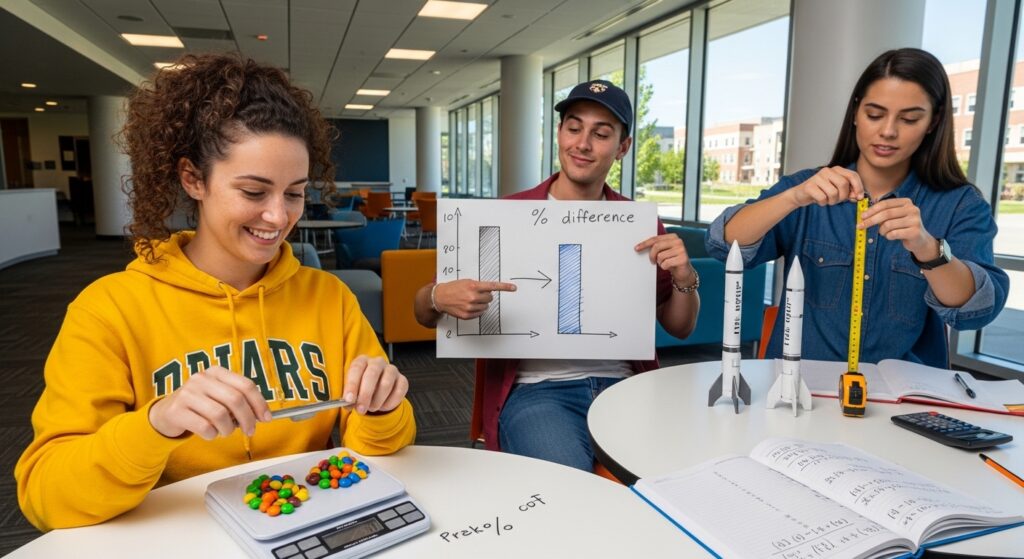
Teachers often make the topic more fun through small projects.
Some classrooms turn comparisons into games. For example, students might compare:
• Heights of famous landmarks
• Prices of snacks in different stores
• Scores from school sports competitions
• Fundraising totals between classes
A math teacher once said during a workshop:
“When students see percent difference in real life, the formula suddenly makes sense.”
Worksheets, math tasks, and percentage calculation for students become far less scary when connected to real experiences.
And yes, sometimes chocolate bars are involved.
Frequently Asked Questions
percentage difference formula
The percentage difference formula is used to measure the relative difference between two values. It is calculated by dividing the absolute difference of the numbers by their average and then multiplying by 100.
percent difference equation
The percent difference equation is:
∣a−b∣÷2(a+b)×100.
This equation compares two numbers and expresses their difference as a percentage of their average.
how to calculate percent difference
To calculate percent difference, first find the absolute difference between the two numbers. Then divide this difference by their average and multiply the result by 100 to get the percentage.
what is the percentage difference between two numbers
The percentage difference between two numbers shows how much they differ relative to their average value. It helps compare two quantities without indicating increase or decrease.
calculate percent difference
To calculate percent difference, subtract the two numbers to get the absolute difference, divide it by their average, and multiply by 100. The final result is expressed as a percentage.
Read this Blog: https://marketmetl.com/rare-pokemon-cards/
Final Thoughts: Understanding Percent Difference with Confidence
At first glance, Percent Difference feels like just another formula buried inside a math chapter. But once you look closer, it becomes something more interesting.
It’s a tool for understanding the relationship between values, for turning raw numbers into meaningful comparisons.
Whether you’re studying mathematical concepts, analyzing data, or simply comparing everyday prices, the percentage difference formula helps reveal the story hidden inside numbers.
If you’re learning this concept for the first time, try practicing with simple examples. Compare the weights of snacks, the heights of friends, or even the prices of books online. Little experiments like that build intuition faster than memorizing formulas ever will.
And if you’re a teacher or student reading this, consider creating your own percent difference worksheets or fun learning percentages step by step activities. Numbers start behaving nicely once you play with them a bit.