Have you ever tried to imagine a distance and suddenly your brain just… refuses to cooperate? Someone says “move the table about twenty feet” and your mind kinda shrugs like, hmm yeah sure that sounds right I guess.
Truth is, humans are weirdly bad at visualizing measurements. We hear numbers like 20 feet, and unless there’s a measuring tape in our hand or a wall to pace along, it’s just a floating number in space.
To put the mathy bit upfront, 20 feet equals 240 inches, which also converts to 6.1 meters or roughly 6.67 yards. Numbers like these are useful, yes, but they still don’t paint a picture.
What we really need is a length comparison tied to stuff we actually see in daily life vehicles, buildings, animals, even sports courts.
That’s where real-world size examples come in. They help build spatial visualization, which is just a fancy way of saying your brain learning what distance actually feels like. Builders, architects, delivery drivers, and folks working in urban planning use this skill all the time.
And if you’ve ever tried to estimate distance without tools, maybe pacing a garden or measuring a room, you probably used the step measurement method without even knowing it.
The average adult step is about 2.5 feet, so 20 feet approximates about 8 walking steps. Not perfect, but close enough for everyday distance estimation.
In this article we’ll explore fifteen objects and situations that make 20 feet easier to imagine. Some are surprisingly ordinary. Others might make you pause and say, oh wow… that’s actually bigger than I thought.
Let’s take a walk through space, one comparison at a time.
| # | Real-World Example | How It Relates to 20 Feet | Quick Context |
|---|---|---|---|
| 1 | Standard shipping container | Length is 20 feet | Common in global transport logistics and cargo shipping |
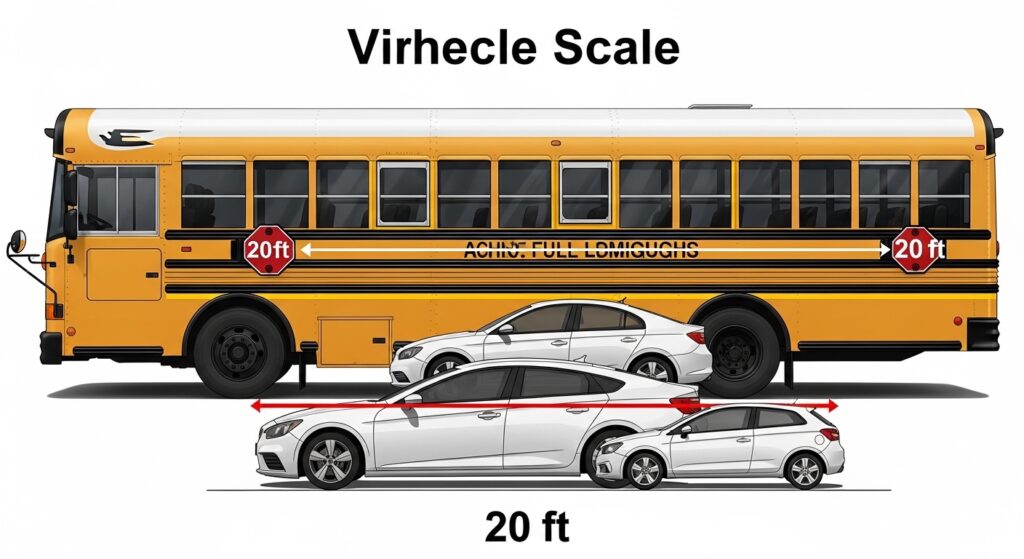
| 2 | Small school bus | Around 20 feet long | Used in some school transportation systems |
| 3 | Delivery truck | Approximately 20 feet in length | Typical for urban commercial box trucks |
| 4 | Mobile food truck | Roughly 20 feet long | Popular at festivals and street food markets |
| 5 | Pontoon boat | About 20 feet long | Common recreational pontoon boats on lakes |
| 6 | Two-story home | About 20 feet tall to roofline | Standard residential construction dimensions |
| 7 | Extension ladder | Often 20 feet long | Used for roof access and maintenance |
| 8 | Residential flagpole | Around 20 feet high | Typical height for home flag displays |
| 9 | Two-car garage width | Roughly 20 feet wide | Standard garage size in many houses |
| 10 | Large living room | Around 20 feet across | Common in open-concept home designs |
| 11 | Indoor swimming pool width | About 20 feet wide | Typical backyard pool dimension |
| 12 | Giraffe height | 18–20 feet tall | One of the tallest animals on Earth |
| 13 | Tennis court comparison | 20 ft is a little over half of the 36-ft width | Useful sports length comparison |
| 14 | Basketball court comparison | 20 ft ≈ 1/5 of the 94-ft court length | Based on official court regulations |
| 15 | Walking steps | About 8 steps | Based on 2.5-foot average step in the step measurement method |
Understanding the Measurement: What Exactly is 20 Feet?
Before diving into comparisons, it helps to grasp the raw numbers for a moment.
The main measurement here is simple:
- 20 feet = 240 inches
- 20 feet = 6.1 meters
- 20 feet = 6.67 yards
For people used to the metric system, 6.1 meters is about the height of a small building wall or the length of a large room.
Professionals typically measure distances like this using measurement tools such as:
- a measuring tape
- a laser distance meter
- long construction rulers
- wheel distance counters
But interestingly, in many everyday cases, people rely on estimation. Builders sometimes pace distances, warehouse workers gauge spacing visually, and delivery drivers intuitively judge whether a delivery truck will fit into a loading zone.
That’s where measurement reference points become incredibly helpful. When your brain learns that a certain object equals around 20 feet, you start recognizing that distance almost automatically.
So now, let’s explore some examples.
Vehicles That Are About 20 Feet Long
Transportation gives us some of the clearest real-life size references. Vehicles are standardized, engineered, and fairly consistent in dimensions, which makes them great for distance measurement comparisons.
A Standard Shipping Container
One of the most famous references is the Standard shipping container (20-foot container) used in global trade.
These containers follow the International shipping container standard, meaning their length is almost exactly 20 feet.
If you’ve ever seen stacks of containers at a port or on a cargo train, each one represents this measurement perfectly. In transport logistics, these containers are the backbone of global shipping.
A Small School Bus
Some smaller school transportation systems use buses that are close to 20 feet long.
Imagine lining up kids for a field trip. The bus parked by the curb gives you a pretty accurate mental picture of this distance.
A Delivery Truck
Many commercial box trucks used for city deliveries measure roughly 20 feet from front bumper to cargo door.
Think of the trucks that bring furniture or appliances. When you stand beside one, that’s basically the length we’re talking about.
A Mobile Food Truck
Food trucks used in festivals or city markets often measure close to this length too. These vehicles are designed to balance mobility with kitchen space.
In other words, if you’ve ever waited in line for tacos from a truck you were probably standing next to 20 feet of vehicle.
A Midsize Sedan and Pickup Truck Together
Park a midsize sedan and a pickup truck end-to-end and you’ll get roughly 20 feet.
It’s a surprisingly relatable comparison because most people have seen cars parked like that in driveways or parking lots.
Vehicles make excellent references because they’re common and consistent your brain stores their size easily.
Architecture Examples That Help Visualize 20 Feet
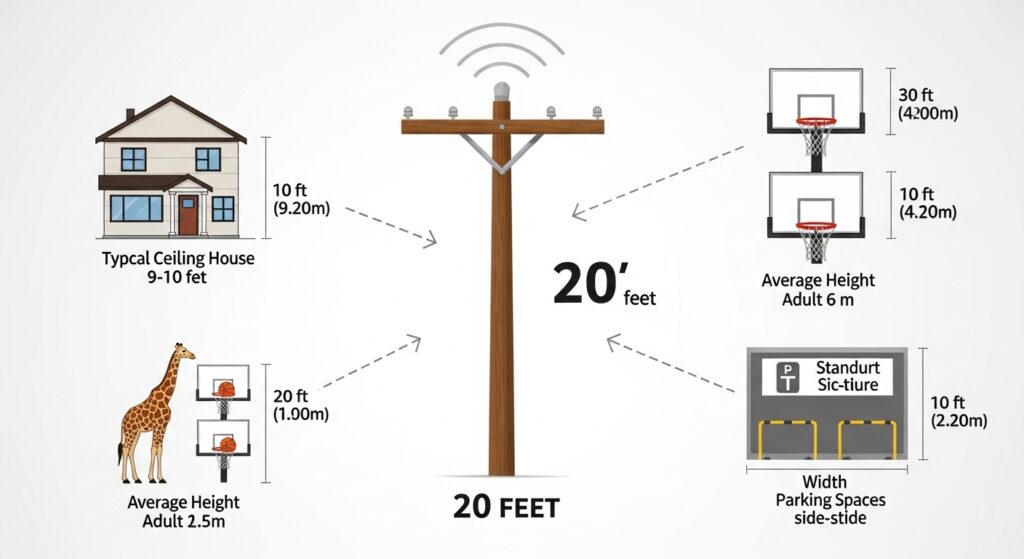
Buildings provide another excellent measurement reference because construction follows predictable dimensions.
The Height of a Two-Story Home
Many suburban houses reach about 20 feet from ground to roofline.
This doesn’t include the attic peak, but the main structure of a two-story home often lands right around that height.
Builders use this measurement when planning residential construction dimensions and structural clearances.
An Extension Ladder
A standard extension ladder frequently measures 20 feet.
These ladders are designed with safety rules known as ladder safety ratios, ensuring firefighters, painters, and contractors can safely reach roofs and upper windows.
If you’ve ever seen a ladder leaning against a house, imagine stretching it fully upward that’s about the length we’re discussing.
A Residential Flagpole
Many homes install residential flagpoles around 20 feet tall.
This height allows the flag to be visible without overpowering the house. In fact, local building codes sometimes recommend this range.
A Living Room in an Open House Design
In modern architecture, a large living room in an open-concept home might stretch roughly 20 feet across.
Interior designers use these dimensions frequently in commercial building design and upscale residential layouts.
The Width of a Two-Car Garage
Many two-car garage designs are around 20 feet wide.
This allows space for two vehicles plus minimal walking clearance.
Once you picture that width, suddenly 20 feet feels less abstract.
Outdoor Infrastructure That Measures About 20 Feet
City planners and designers often work with standard dimensions when designing public spaces.
Parking Lane Width
In parking lot design, some access lanes or loading areas measure close to 20 feet wide.
This width ensures vehicles can maneuver safely.
Residential Lot Width Sections
In certain suburban developments, parts of a residential lot width can measure around 20 feet, especially side yard spacing.
Urban planners consider these measurements during city infrastructure planning.
Commercial Awnings
Large storefront commercial awnings often stretch about 20 feet across a shop entrance.
Walk down a busy retail street and you’ll see this measurement repeated again and again.
Retail Storefront Width
Many small shops have retail storefronts approximately 20 feet wide.
This measurement is common in historic downtown districts.
Public Park Benches
Line up several park benches end-to-end and you’ll reach around 20 feet.
This type of public seating layout is often used when designing parks or waterfront spaces.
Infrastructure examples are great because they surround us daily we just rarely notice the measurements.
Sports and Recreation Comparisons

Sports facilities are full of standardized dimensions, which makes them perfect for measurement learning guides.
Tennis Court Reference
A tennis court measures 36 feet wide according to official tennis court dimensions.
So 20 feet is just over half the width of the court.
If you’ve watched tennis before, imagine standing near the center and walking halfway toward the sideline.
Basketball Court Comparison
According to basketball court regulations, a court measures 94 feet long and 50 feet wide.
So 20 feet is:
- about one-fifth of the court’s length
- less than half its width
This makes 20 feet compared to basketball court a surprisingly useful visual reference.
Swimming Pool Width
Some backyard swimming pool designs measure around 20 feet across.
Stand on one edge and look to the other side that’s the distance.
Sports facilities give us standardized measurements that help build accurate spatial awareness.
Nature’s Giant Example: The Height of a Giraffe
Nature sometimes provides the most dramatic comparison.
An adult giraffe height ranges between 18 and 20 feet when standing tall.
That means if a giraffe walked into your neighborhood (which hopefully it never does lol), its head could reach the height of a small building.
Wildlife experts often use this comparison when teaching kids about animal scale.
Suddenly 20 feet becomes something living, breathing, and towering above us.
Marine and Aviation Examples
Watercraft and aircraft also give interesting references.
Pontoon Boats
Many pontoon boats used for lake recreation measure about 20 feet long.
These boats are popular because they balance space and maneuverability.
Small Aircraft Wingspan
Certain training planes have a small aircraft wingspan close to 20 feet.
Aircraft designers carefully calculate wingspans during aviation wingspan design to balance lift and stability.
If you’ve seen a small plane parked at an airfield, its wings might stretch almost exactly that distance.
How to Measure 20 Feet Without Tools

Sometimes you don’t have a measuring tape or laser distance meter nearby. Luckily, there are simple tricks.
Step Measurement Method
Remember earlier: the average adult step equals about 2.5 feet.
So you can estimate 20 feet by walking 8 steps.
It’s not perfect, but it works surprisingly well for quick measurements.
Using Familiar Objects
You can also estimate distance using objects like:
- a parked truck
- a garage width
- a swimming pool span
- a line of benches
These everyday references build stronger scale estimation skills over time.
Builders, landscapers, and delivery drivers actually develop this ability naturally.
Why Learning to Visualize Measurements Matters
You might wonder why any of this matters.
But spatial visualization plays a huge role in daily life.
Architects rely on it for architectural measurements, warehouse managers use it for warehouse planning, and city designers use it for urban delivery trucks routing and street layout.
Even regular homeowners use these skills when planning furniture layouts, backyard patios, or driveway space.
Learning a few solid real-world measurements like 20 feet becomes a surprisingly powerful mental tool.
Frequently Asked Questions
how long is 20ft
20 feet equals 240 inches, 6.67 yards, or about 6.1 meters. It’s roughly the length of a small room, a large truck, or about eight average adult steps.
how big is 20 feet
Twenty feet is considered a moderate distance in everyday spaces—about the height of a typical two-story house or the length of a standard shipping container.
20 feet visualized
To visualize 20 feet, imagine four park benches placed end-to-end or a medium-sized delivery truck parked along a curb.
20 feet example
Common examples of objects around 20 feet include a shipping container, a school bus section, a pontoon boat, or a residential flagpole.
what does 20 feet look like
Twenty feet looks like the distance across a small indoor pool or the height of a tall giraffe, giving a clear sense of how tall or long this measurement can be in real life.
Read this blog: https://marketmetl.com/hos-long-6-inches/
Final Thoughts: Turning Numbers into Images
Numbers alone rarely stick in our memory. But stories, objects, and real-life comparisons do.
Now when someone asks “how long is 20 feet in real life?”, you’ve got plenty of answers:
- the length of a shipping container
- the height of a two-story home
- a fully extended extension ladder
- the span of a pontoon boat
- the towering height of a giraffe
You can even pace it out in eight steps if nothing else is nearby.
Measurements stop feeling abstract once they connect to the world around us.
And honestly… the next time you see a 20-foot container rolling down the highway or a flag waving from a tall pole, you might catch yourself thinking:
Ohhh… so that’s what twenty feet really looks like.
If you’ve got your own favorite comparison maybe something unusual or funny share it with others. People learn measurements best when they’re tied to everyday life, and sometimes the weirdest examples stick the longest.