There’s something oddly tender about numbers, isn’t there? We think they’re stiff, all bones and no heart, but then you’re standing in your kitchen at 6:17 p.m.,
flour on your cheek, trying to bake a cake for someone you love, and suddenly a number feels like a tiny panic attack.
The recipe says 175°C (degree Celsius) and your oven blinks back at you in Fahrenheit like it’s speaking a diffrent dialect of the same language.
You sigh. You google. You wonder why the world couldn’t just pick one way to measure heat and stick with it, honestly.
And that’s where our story begins with 175, with curiosity, with a need to convert something so it makes sense in your own world.
So let’s answer it plainly, warmly, properly:
175°C equals 347°F (degree Fahrenheit).
Yes. 175 on the Celsius scale (°C) becomes 347 on the Fahrenheit scale (°F). Not 350°F (though many recipes round it), not “about medium hot,” but exactly 347°F when you do the math right.
But we’re not just here for a number. We’re here to understand what it means, how it works, and why it even matters in the first place.
| Celsius (°C) | Formula Used | Fahrenheit (°F) |
|---|---|---|
| 175°C | (175 × 9/5) + 32 | 347°F |
Understanding 175°C (Degree Celsius) in Fahrenheit Through Simple Conversion
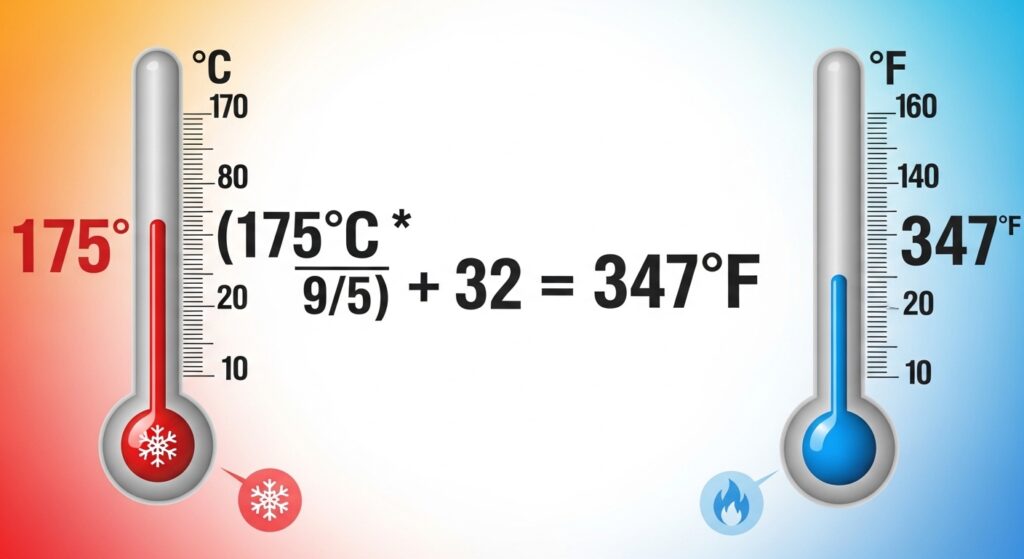
When we talk about Celsius to Fahrenheit, we’re really talking about two ways of describing the same warmth, like two poets arguing over the same sunset. The formula to convert from Celsius to Fahrenheit is:
F = (C × 9/5) + 32
So when we take 175 and gently multiply it by 9/5, we get 315. Then we add 32, and voilà 347.
That’s the official temperature conversion. Clean. Mathematical. Reliable.
But let’s slow it down a sec.
The Celsius scale (°C) belongs to the SI system (International System of Units). It’s tidy and logical. Water freezes at 0°C, boils at 100°C. The math is friendly, divisible, cooperative.
Meanwhile, the Fahrenheit scale (°F) lives inside the Customary system (Imperial/US system), used mostly in the United States.
On this scale, the freezing point of water is 32°F, and the boiling point of water is 212°F. Slightly dramatic numbers, if you ask me.
So when you’re shifting between them, you’re not just moving numbers around. You’re translating between systems that were built with different philosophies, different histories, different ways of seeing heat.
Why 175°C (Degree Celsius) and 347°F (Degree Fahrenheit) Matter in Real Life
Now here’s where things get practical. Because sure, it’s nice to know that 175°C equals 347°F, but when does this actually matter?
Cooking. Baking. Roasting. That slightly-too-crispy lasagna incident we don’t talk about.
Many European and Australian recipes list oven settings in Celsius. Many American ovens display Fahrenheit. So when a cake calls for 175°C (degree Celsius) and you accidentally set your oven to 175°F instead? Well.
That cake will sit there pale and confused for hours. It won’t brown. It won’t rise right. It will just exist in a lukewarm identity crisis.
On the flip side, if you mistake 347°F (degree Fahrenheit) for 175°F disaster. Total meltdown. Literally.
So understanding this conversion is not academic trivia. It’s dinner.
It’s also useful in science labs, manufacturing, weather comparisons, and anywhere global collaboration happens. Because heat doesn’t change based on geography only the way we measure it does.
The Science Behind the Temperature Scale Differences
Let’s take a breath and talk about the bones beneath the skin of these numbers.
The Celsius scale (°C) was designed around water’s behavior. The freezing and boiling points were chosen intentionally: 0°C and 100°C. It’s decimal.
It’s neat. It plays well with the SI system (International System of Units), which most of the world uses for scientific consistency.
The Fahrenheit scale (°F), created earlier, was based on reference points that made sense at the time but feel, well, less symmetrical now.
With water freezing at 32°F and boiling at 212°F, you get 180 degrees between those two points instead of 100.
And that’s why the formula exists. That little ×9/5 + 32 bridge is there because the scales don’t align neatly. They’re offset, stretched differently, anchored differently.
It’s kind of beautiful, in a nerdy way.
When you explore it deeply, you realize temperature scales are stories humans told about heat. They’re agreements. They’re frameworks that set standards so we can cooperate across borders.
Easy-to-Use Calculator and Interactive Tool Options
Now, maybe you’re thinking, “Okay but do I really need to remember the formula every time?” And honestly? Not really.
Today, we have every kind of easy-to-use calculator imaginable. A quick online search gives you an interactive tool where you type 175 into a Celsius box and it instantly shows 347 in Fahrenheit. No paper. No math. No muttering under your breath.
These digital helpers make temperature conversion seamless. You can flip from Celsius to Fahrenheit, or from Fahrenheit to Celsius, in seconds.
Still, there’s something quietly empowering about knowing how it works. About understanding why 175 becomes 347. It makes the number less mysterious. Less bossy.
Comparing 175°C to Familiar Temperature Benchmarks
Let’s anchor this in something you already know.
Water freezes at 0°C or 32°F.
Water boils at 100°C or 212°F.
So where does 175°C (degree Celsius) sit?
It’s well above boiling water. It’s oven territory. It’s hot enough to roast vegetables, bake cookies, crisp chicken skin. It’s not industrial furnace heat, not volcanic magma energy but it’s serious kitchen heat.
In Fahrenheit terms, 347°F (degree Fahrenheit) is just under the commonly rounded 350°F setting that many recipes use as a “moderate oven.”
So when a cookbook says “Bake at 175°C,” it’s essentially asking for moderate, steady, reliable heat. The kind that transforms batter into cake and dough into bread without scorching the edges into sadness.
A Brief Historical Peek at the SI System and Customary System
The SI system (International System of Units) was created for global consistency. Scientists needed a universal language. Celsius fit beautifully into that because of its decimal structure and clean relationship to water’s phase changes.
The Customary system (Imperial/US system) evolved differently, shaped by older British measurement traditions.
Fahrenheit stuck around in the U.S., partly out of habit and partly out of infrastructure momentum. Thermostats, ovens, weather forecasts once they’re built one way, change becomes expensive and culturally sticky.
And so here we are. Two systems. Same heat. Different storytelling.
When you convert between them, you’re participating in a small act of international diplomacy. Which sounds dramatic, but it’s true.
Common Mistakes When Converting 175 Degrees
Let’s talk about what goes wrong.
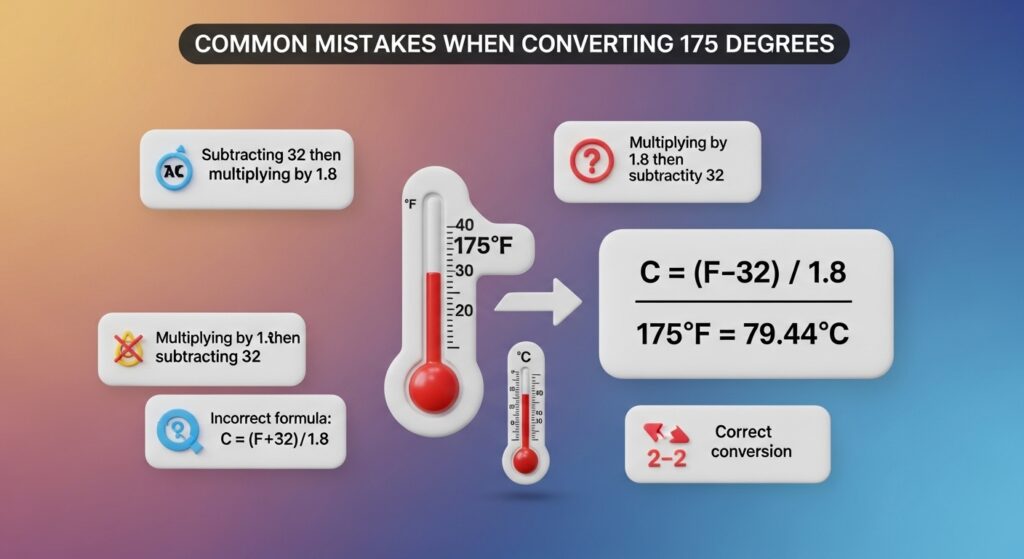
One common mistake is forgetting to multiply before adding 32. If you add 32 first, the math unravels like a badly knitted sweater.
Another is rounding too early. While 175°C equals exactly 347°F, many people round to 350°F for convenience. That’s usually fine for cooking, but if precision matters like in certain chemical experiments those degrees matter.
And sometimes people mix up the direction entirely, trying to use the same formula for Fahrenheit to Celsius. That requires a different rearranged formula:
C = (F − 32) × 5/9
See? Similar but not identical. Like cousins who look alike but have very diffrent personalities.
Why Understanding Temperature Conversion Still Matters in a Digital World
You could rely entirely on an interactive tool and never learn the underlying math. That’s an option. We outsource memory to our devices all the time.
But knowing how to explore a temperature scale, how to manually convert between them, builds a quiet confidence. It sharpens number sense. It makes you less dependent on battery life.
And in educational settings, especially science classrooms, understanding the relationship between Celsius to Fahrenheit reinforces broader concepts about ratios, linear equations, and measurement systems.
It’s not just about heat. It’s about pattern recognition.
How to Quickly Estimate 175°C in Fahrenheit Without a Calculator
Here’s a small trick people sometimes use for rough mental math:
Double the Celsius temperature and add 30.
For 175, doubling gives 350. Add 30 and you get 380°F which overshoots the real answer of 347°F (degree Fahrenheit). So this method is quick but not precise.
A slightly better mental method is:
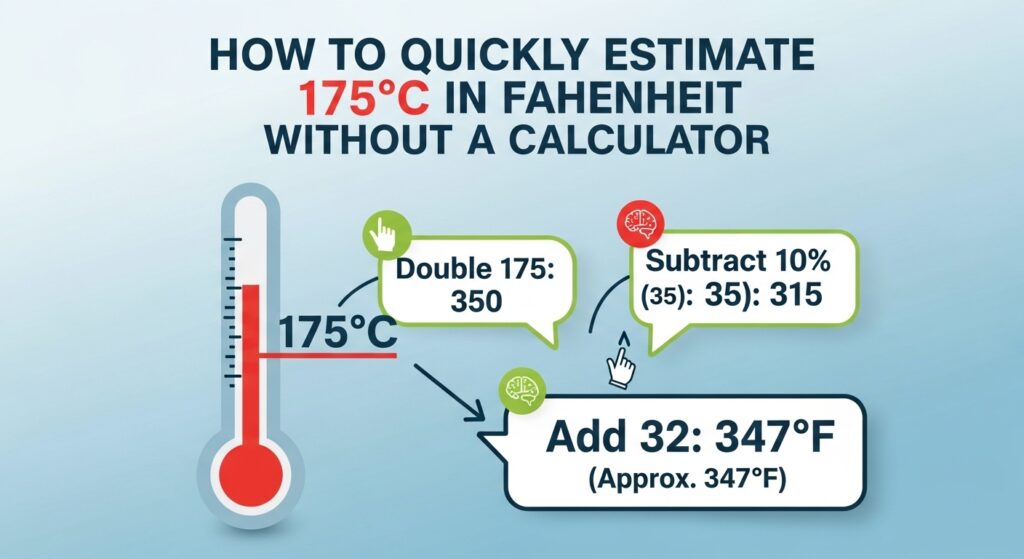
Multiply by 2, subtract 10%.
175 × 2 = 350
10% of 350 is 35
350 − 35 = 315
Then add 32 → 347
It’s still mathy, but it works. And when you land on 347, there’s a tiny spark of satisfaction. Like solving a puzzle in your own head without asking for help.
The Emotional Side of Numbers (Yes, Really)
This might sound strange, but numbers like 175°C (degree Celsius) and 347°F (degree Fahrenheit) represent more than measurements. They represent adaptation. Communication. The willingness to translate rather than demand uniformity.
The world could’ve insisted on one temperature scale. Instead, we learned to build bridges.
And every time you convert between Celsius to Fahrenheit, you’re practicing that bridge-building in miniature.
It’s kind of poetic, if you squint at it sideways.
Frequently Asked Questions
175 celsius to fahrenheit
175°C is equal to 347°F.
what is 175 celsius in fahrenheit
175 degrees Celsius converts to 347 degrees Fahrenheit.
175 derece kaç fahrenheit
175°C is 347°F in the Fahrenheit scale.
175c in fahrenheit
175°C equals 347°F.
175c to f oven
Set your oven to 175°C, which is 347°F in Fahrenheit.
Read this Blog: https://marketmetl.com/what-is-170-degrees-celsius-in-fahrenheit/
Final Answer, Clearly Stated
So let’s end where we began, but this time with full clarity and context:
175°C (degree Celsius) equals 347°F (degree Fahrenheit).
It sits comfortably above the boiling point of water at 100°C (212°F) and far above the freezing point of water at 0°C (32°F). It’s a standard moderate oven temperature used widely in baking and roasting.
It exists within the logic of the Celsius scale (°C) under the SI system (International System of Units) and translates into the Fahrenheit scale (°F) used in the Customary system (Imperial/US system).
And now you know not just the number, but the why behind it.
If you’ve ever misread an oven dial or nervously second-guessed a recipe, you’re not alone. Drop your kitchen conversion stories in the comments I’d genuinely love to hear them. Did you once bake something at 175°F instead of 347°F and wait… and wait… and wait? We’ve all been there.
In the end, it’s just math. But it’s also understanding. And sometimes understanding warms you up in ways no oven ever could.