There’s a moment, right before the lights go out at the Las Vegas Grand Prix in Las Vegas, United States, when everything feels like it’s holding its breath. Engines humming like caffeinated hornets.
The asphalt shimmering under floodlights. You sit there thinking, not casually but almost childishly, how fast do F1 cars go, really?
Not just numbers on a screen, but in-your-chest, rearranging-your-organs kind of fast. And then the lights vanish, and twenty machines launch forward like gravity’s been politely ignored. It’s not just speed. It’s velocity with intent.
I’ve stood near a track before earplugs in, heart still rattling and when an F1 car flashes past, your brain sort of lags behind, like it needs a second to catch up to what your eyes just saw.
So let’s talk about it properly. Not in dry statistics, but in the living, breathing madness of Formula 1 (F1) and the outrageous physics it plays with.
Here’s a short, straight-to-the-point table answering: How fast do F1 cars go?
| Category | Speed / Data | Notes |
|---|---|---|
| Average Top Speed | 210–220 mph (337–354 km/h) | Seen at power circuits like Monza |
| Official Race Speed Record | 231 mph | Valtteri Bottas – 2016 Mexican Grand Prix |
| Highest Recorded (Test) | 231.5 mph | Juan Pablo Montoya – Monza 2005 |
| 0–60 mph (0–100 km/h) | 1.6–2.7 seconds | Faster than most hypercars |
| 0–100 mph | ~4 seconds | Extreme acceleration |
| Hard Braking (200–0 mph) | ~4–5 seconds | Carbon brakes + downforce |
| Average Race Speed (Typical Circuit) | 150–160 mph | Depends on track layout |
| Fastest Average Race Speed | 206.374 km/h (128.2 mph) | Italian Grand Prix (Monza) |
| Cornering Speed | 180+ mph in fast corners | Thanks to high downforce |
| Engine Power | 1,000+ horsepower | 1.6L turbocharged hybrid V6 |
How Fast Do F1 Cars Go on a Straight?
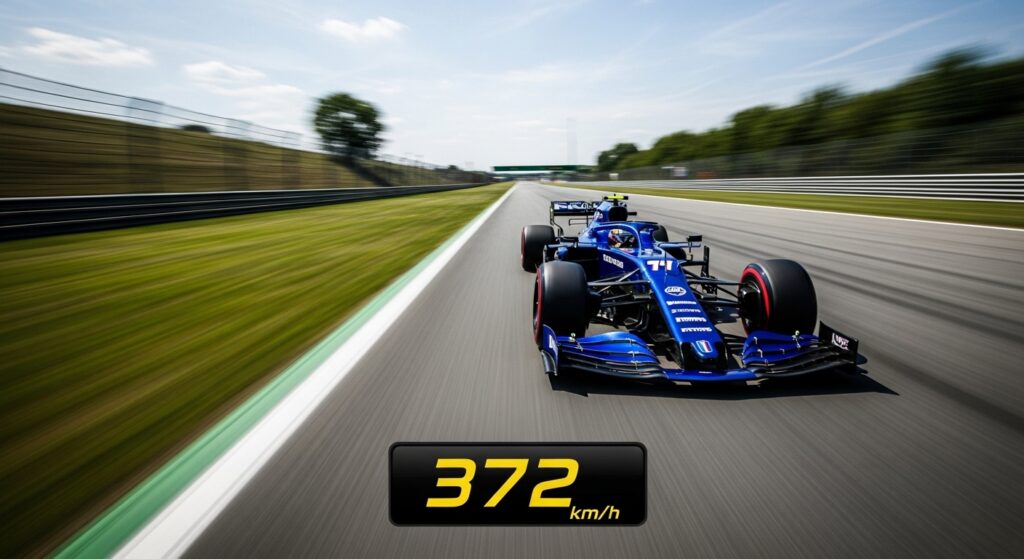
Let’s get straight to the bit everyone Googles at 2 a.m.: How fast do F1 cars go in terms of top speed? On long straights like Monza, Italy temple of speed, cathedral of chaos modern cars regularly hit 210–220 mph (average maximum speed). That’s not theoretical. That’s actual, wind-tearing, visor-shaking velocity.
The official F1 top speed record in a race weekend belongs to Valtteri Bottas, who clocked 231 mph in the slipstream at the 2016 Mexican Grand Prix. Before that,
Juan Pablo Montoya had set a blistering 231.5 mph (Montoya record) during testing with McLaren-Mercedes in 2005 at Monza. Tiny difference in numbers, massive difference in goosebumps.
Speed trap readings at Monza during the 2005 Italian Grand Prix regularly pushed past the 200+ mph benchmark, and back in the 1950s?
Cars at the 1953 French Grand Prix were doing around 180 mph (1950s F1), which felt apocalyptic for the time. Today, that’s… well, brisk.
But straight-line speed doesn’t tell the whole story. In fact, it barely tells half of it.
Formula 1 Speed Is More Than Just Top MPH
If you’re only looking at F1 top mph, you’re kinda missing the magic trick. Because Formula 1 speed is a symphony of cornering grip, braking violence, and acceleration that makes supercars look slightly confused.
A Bugatti Chiron might win a drag race in a controlled environment. But on a circuit like Circuit de Spa-Francorchamps (Belgium)? An F1 car would absolutely dismantle it over a lap. Why? Downforce. Grip. Relentless engineering obsession.
Modern cars produce so much downforce in Formula 1 that at high speeds they could, theoretically, drive upside down in a tunnel. It’s that wild.
The cutting-edge aerodynamics, sculpted front and rear wings, and intricate underbody design create suction-like grip. It’s speed glued to the road.
And that’s before we even talk about the engine.
The Brutal Beauty of F1 Acceleration
Now here’s where things get properly ridiculous. F1 acceleration from 0–60 mph happens in roughly 0–60 mph in 1.6–2.7 seconds. That’s not a typo. Some estimates put the F1 0–60 time closer to 1.8 seconds under ideal conditions.
For context, an IndyCar hits 90 mph in 3 seconds (IndyCar), which is also insane. But F1 cars combine that launch with insane braking.
They can go from 200 mph to a near standstill in about four seconds. Your road car would need a quiet moment afterward.
This is possible because of the 1.6-liter V6 internal combustion engine, paired with turbocharged hybrid power units and the all-important Energy Recovery System (ERS).
The Energy recovery system F1 captures braking energy and exhaust gases, converting them into a power boost. Think of it as recycling, but for speed.
These engines produce 1,000+ hp, delivered through a meticulously balanced carbon fiber chassis weighing the 798 kg minimum weight mandated by FIA (Federation Internationale de l’Automobile) regulations. In 2026, that drops to 768 kg (2026 regulation), which means even sharper reactions. Less weight. More chaos.
How Fast Do F1 Cars Go Around a Lap?
Here’s where it gets spicy. Because the real measure of performance isn’t just straight-line velocity. It’s F1 lap times.
At the 2021 Circuit de Monaco, pole positions hover around the 1:10.346 lap time range. Monaco isn’t about top speed; it’s about threading a needle at 170 mph while pretending you’re calm.
At the Circuit de Barcelona-Catalunya, we’ve seen pole times like 1:16.330 lap time, while a scorching 1:05.619 lap time at Austria’s Red Bull Ring (Austria) shows just how fast a short track can be when optimized.
During the Styrian Grand Prix 2020, lap speeds were so high it almost felt disrespectful to physics. And in Japan?
The Japanese Grand Prix 2016 showcased high-speed sections that demand absolute commitment from drivers like Lewis Hamilton, Max Verstappen, and Fernando Alonso.
Average speed comparisons tell an interesting story. In a 2019 Circuit of America F1 vs IndyCar comparison, F1 averaged 206.374 km/h average (F1) versus 186.349 km/h average (IndyCar). Not a landslide, but enough to underline the difference in motorsport speed comparison debates.
Speed Records in F1: Legends and Landmarks
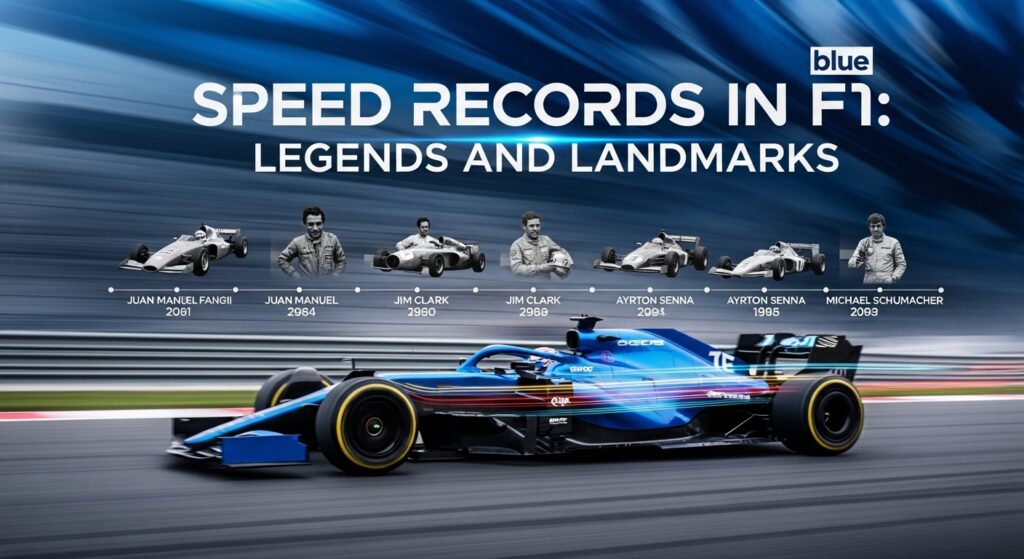
Let’s talk about Speed records in F1, because they read like mythology.
• Valtteri Bottas 231 mph in Mexico
• Juan Pablo Montoya 231.5 mph testing record
• Michael Schumacher redefining consistency and dominance
• Lewis Hamilton most pole positions, relentless pace
• Max Verstappen youngest world champion, terrifyingly precise
• Jack Brabham old-school bravery at raw speeds
• Charles Leclerc and Carlos Sainz modern era qualifying masters
The Guinness World Record books often track the fastest pit stops, shortest margins, tightest championships. But raw speed? That’s written into asphalt and tire smoke.
And let’s not forget the 200 mph milestone (1968), when F1 first officially broke that barrier. It changed everything. Suddenly, speed wasn’t just impressive. It was existential.
F1 Car Performance: Engineering at the Edge
You can’t talk about F1 car performance without bowing slightly to the engineers. Teams like Red Bull Racing, Williams, and the McLaren F1 Team MCL35 Renault don’t just build cars they build rolling research labs.
The Williams FW36, for example, was known for straight-line efficiency. The classic Lotus 49 revolutionized engine integration. The Red Bull-TAG Heuer RB12 showcased aerodynamic genius.
Each car is shaped by FIA regulations, which control minimum weight F1 car, fuel flow, and aerodynamics. The balance between drag and downforce is a constant chess match.
Tires? Don’t underestimate Pirelli and their delicate, temperamental tire compounds. Soft compounds grip like glue but degrade quickly. Hard compounds last longer but don’t bite as fiercely. It’s strategy at 200 mph, which is slightly bonkers if you think about it too long.
Motorsport Speed Comparison: F1 vs Everyone Else
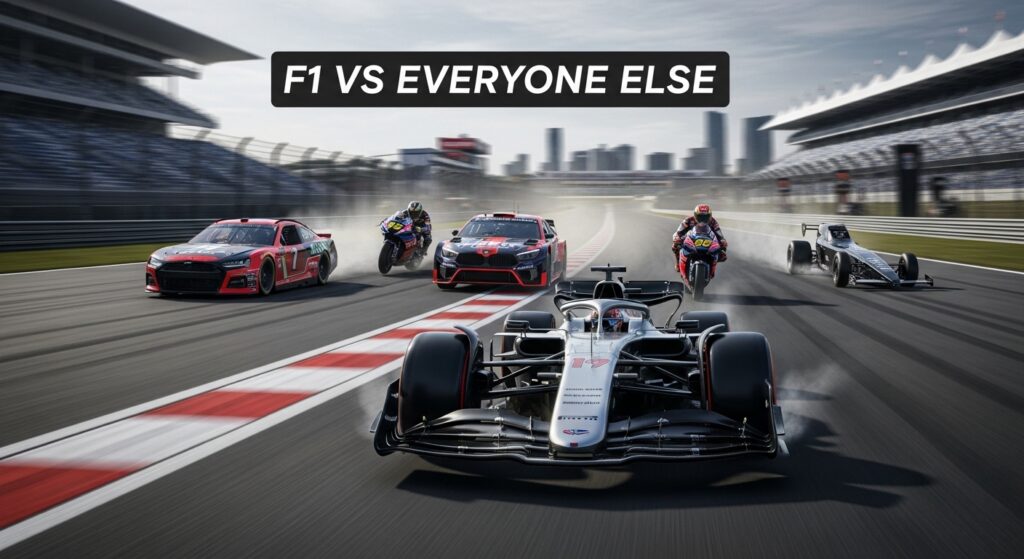
People love asking about F1 vs IndyCar speed comparison, or even F1 vs MotoGP and F1 vs NASCAR.
On ovals, NASCAR can hit around 200 mph (NASCAR top speed) consistently. IndyCar shines on superspeedways.
But on technical circuits like Circuit de Spa high-speed track or Monaco? F1 dominates because of cornering speed.
MotoGP bikes accelerate brutally and lean at impossible angles. Yet they lack the downforce magic that lets F1 cars carry absurd speeds through turns.
Straight-line speed vs cornering speed that’s the heart of it. On a pure drag strip, an F1 car isn’t always king. Over a lap? It’s royalty with a crown welded on.
The Evolution of Speed: From 1953 to 2026
Back at the 1953 French Grand Prix, 180 mph felt like stepping into the unknown. Drivers wore open-face helmets and courage like armor.
Fast forward to the Austrian Grand Prix in Spielberg, Austria, and you see telemetry streams, hybrid deployment maps, and micro-adjustments in brake bias mid-corner.
The F1 hybrid power unit era brought efficiency without sacrificing violence. The turbocharged V6 F1 engine changed the soundscape less scream, more snarl but improved energy deployment.
With F1 regulations 2026 changes reducing weight and increasing electrical output, we’re looking at potentially quicker acceleration and smarter energy distribution. Not necessarily higher top speeds, but faster laps. And that’s what counts.
Fastest F1 Circuits and Iconic Moments
Some tracks just feel fast even when you whisper their names.
Monza, Italy absurd straight-line speed and legendary slipstreams.
Circuit de Spa-Francorchamps (Belgium) Eau Rouge at full throttle, bravery test.
Red Bull Ring fastest lap territory short, sharp, explosive.
Monaco lap record precision ballet in narrow streets.
Las Vegas Grand Prix neon lights and high-speed spectacle.
2023 Spanish Grand Prix balanced technical challenge.
2021 Circuit de Monaco strategy chess match at blistering pace.
Drivers like Lewis Hamilton, Fernando Alonso, and Max Verstappen have redefined what’s possible on these tracks. They don’t just drive fast. They shave milliseconds like sculptors shaving marble.
So… How Fast Are Formula 1 Cars, Really?
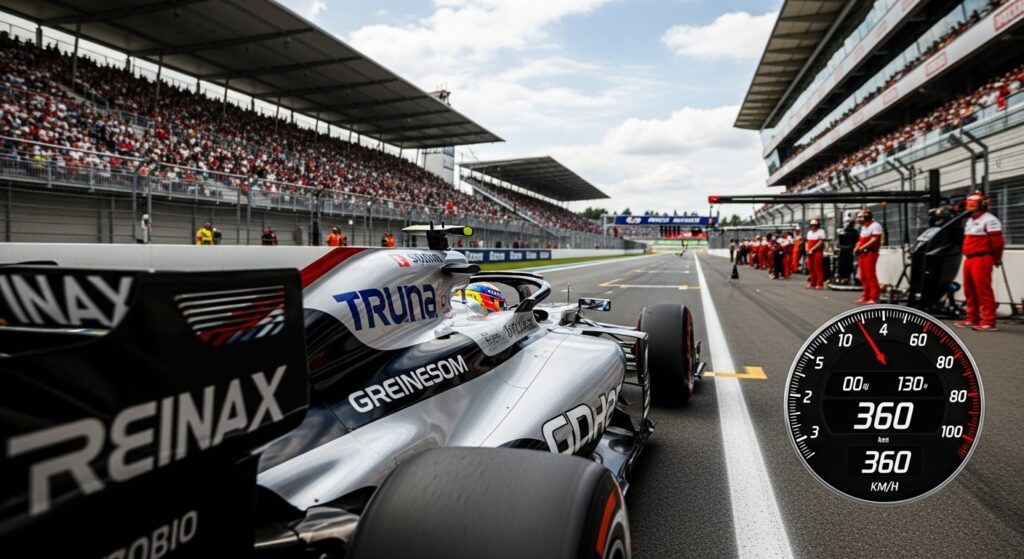
If you want the neat answer: around 210–220 mph, with records touching 231 mph. They accelerate from 0–60 mph in under two seconds. They corner at forces that make fighter pilots nod respectfully.
But that’s not the full truth.
The real answer to how fast are Formula 1 cars is this: fast enough to bend time slightly. Fast enough that a 1:32.029 pole time can feel like a miracle. Fast enough that engineers argue over thousandths of a second as if they’re debating philosophy.
It’s not just about F1 engine horsepower or aerodynamics optimization. It’s about the harmony of machine and human. The way Max Verstappen trusts the front end into a corner.
The way Lewis Hamilton extracts grip from tired rubber. The way a team at the Red Bull Energy Station Las Vegas analyzes data long after the crowd has gone home.
Frequently Asked Questions
how fast do f1 cars go
F1 cars typically reach top speeds between 210 and 220 mph (338–354 km/h) during races. In optimal conditions, they can exceed 230 mph (370+ km/h) on long straights.
how fast do f1 drivers go
F1 drivers travel at speeds over 200 mph (322 km/h) during races, depending on the track layout. Their average lap speeds often range between 150–160 mph (240–257 km/h) on high-speed circuits.
how fast does a formula 1 car go
A Formula 1 car can go up to 220 mph on average, with record speeds reaching around 231 mph (372 km/h). Speed varies based on track design, aerodynamics, and setup.
how fast can f1 cars go
Under ideal conditions with low drag and long straights, F1 cars can go over 230 mph (370 km/h). Most race conditions see maximum speeds slightly above 210 mph.
how fast are f1 cars
F1 cars are among the fastest circuit racing cars in the world, regularly exceeding 200 mph and accelerating from 0–60 mph in about 2 seconds.
Read this Blog: https://marketmetl.com/what-is-70-degrees-celsius/
The Future of F1 Speed
With lighter cars, improved hybrid powertrain systems, and advanced materials in the carbon fiber F1 chassis, the next decade promises smarter speed rather than simply higher numbers.
We may not see 250 mph race speeds due to safety and FIA regulations, but we will see faster lap times. Higher efficiency. Better weight distribution and lower center of gravity. More innovation that trickles down into road cars.
Because that’s the quiet part of this story. Automotive innovation born in F1 ends up in the cars we drive to the grocery store. Energy recovery. Lightweight materials. Even tire durability insights.