Ever sat back on a Sunday afternoon, cup of coffee in hand, staring at the calendar and thought, “Hmm… what day was it exactly, 17 years ago?” Yeah, me too. It’s funny how we tend to remember moments but forget the actual dates they happened on.
Whether it’s for a nostalgic stroll down memory lane, figuring out someone’s age precisely, or just satisfying that random curiosity about history, a years ago calculation can feel like opening a tiny portal to the past. And honestly, it’s more than just a boring date crunch; it’s a way to reconnect with the rhythm of time itself.
Let me tell ya, I once tried manually calculating a birthday for my niece, jotting numbers on scrap paper, crossing them out, scribbling some more… It was chaos.
That’s when I realized that tools like Microsoft Excel, Google Sheets, and even simple Python datetime (Python library) scripts can turn what feels like a headache into a breezy stroll.
And if you’ve ever wondered how people track the years between dates or adjust for leap years, buckle up this is where things get delightfully nerdy.
| Start Date | Years Ago | Past Date | Day of the Week |
|---|---|---|---|
| March 14, 2026 | 1 | March 14, 2025 | Friday |
| March 14, 2026 | 5 | March 14, 2021 | Sunday |
| March 14, 2026 | 10 | March 14, 2016 | Monday |
| March 14, 2026 | 25 | March 14, 2001 | Wednesday |
| March 14, 2026 | 50 | March 14, 1976 | Sunday |
| March 14, 2026 | 100 | March 14, 1926 | Sunday |
Why You Might Need a “Years Ago Calculator”
So, why do we even bother calculating exact dates in the past? Beyond the “just curious” moments, there’s a surprising number of situations:
- Tracking anniversaries with pinpoint accuracy (your first date, first job, or even the day you first met a friend).
- Creating historical timelines for school projects, research papers, or just personal curiosity.
- Calculating a person’s age on any given date, especially when multiple day-of-week references matter.
- Financial or legal needs like checking how long ago a contract started or an investment matured.
- And sometimes, it’s purely for fun… like figuring out what day of the week you were born on.
A years ago calculation isn’t just a number; it’s a little key to revisit the past, with all its subtle joys, regrets, or nostalgic hits.
The Old-School Way: Pencil, Paper, and Chaos
Before computers became our tiny magical time-machines, people did this manually. You’d grab a calendar from decades ago (good luck finding one), jot down the years, adjust for leap year adjustment, and slowly inch towards your answer.
Imagine this scenario: it’s March 14, 2026 (Start Date) and you want to find out exactly what day it was March 14, 1926. That’s a full century of days to account for! You’d need to subtract 100 years, check which years were leap years, and then figure out if the day shifted.
A classic headache. Now imagine trying to verify a table of dates by year or double-checking the weekday calculation. Yeah… humans aren’t really wired for that level of tedium.
Embracing Tech: Online Calculators & Spreadsheets
This is where modern web tools / calculators shine. Today, you can plug dates into a date range calculator, time subtraction calculator, or day of the week calculator, and bam you get instant answers.
- Microsoft Excel: Using the DATE function alongside YEAR(), MONTH(), DAY() functions can automate your date calculation. Want to subtract 50 years from a given date? Formula magic.
- Google Sheets: Works similarly, plus it’s cloud-based, so you can share your historical date chart with friends or colleagues.
- Python scripts: With the datetime (Python library), you can program a years between dates calculator that handles weird edge cases like leap years or invalid date checking.
Even small tweaks like adding a week of year calculation or converting days into hours and minutes using an hours and minutes calculator make a mundane task surprisingly fun.
Fun With Dates: Creating Your Own “Years Ago” Table
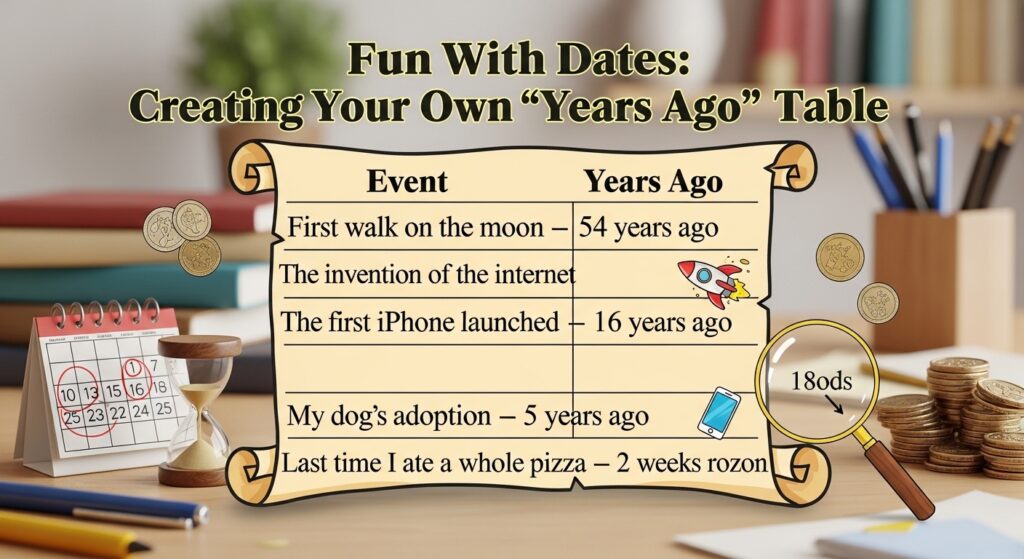
Sometimes, the simplest joy comes from building a little chart. Here’s what I do when I’m feeling extra nerdy:
- Pick a start date. Let’s say March 14, 2026.
- Decide how many years back you wanna go. Could be 10, could be 100.
- Use either Excel, Sheets, or Python to subtract years from date. Remember to adjust for leap years!
- Add the day of the week next to each entry trust me, it’s oddly satisfying.
You end up with something like a years ago chart, where every row tells a little story. March 14, 2025 → March 14, 1926 (years ago chart) suddenly isn’t just numbers; it’s a visual timeline of life.
Categories of “Years Ago” Use-Cases
Not all date calculations are born equal. Let’s break it down into some practical and quirky categories:
Nostalgia & Memory Lane
- “Remember the Monday five years ago when we all stayed up binge-watching cartoons?” Yep, you can figure that out exactly with a day-of-week determination.
- “This Friday was exactly 13 years ago my first concert happened.” Pull the date, and the memory floods back.
- Weeks ago, days ago sometimes it’s easier to think in smaller chunks than years.
Professional & Academic Tracking
- Teachers or professors love a historical timeline analysis to track student progress over the years.
- Research papers sometimes require precise chronology calculation for citations.
- HR teams may use time subtraction for employment anniversaries, promotions, or leave accruals.
Fun & Personal Curiosity
- What day of the week was your birthday March 13, 2021? It’s a Tuesday, by the way (try the day of the week calculator to verify!).
- Who else wants to know what day Joe Sexton was born? Yeah, a little user input-based computation goes a long way.
- Planning a “celebrate a century past” party for March 14, 1926? Knowing the weekday adds authenticity.
Programming Date Calculations Like a Pro
If you’re a coder or a spreadsheet wizard, here’s where things get juicy. A simple Python datetime snippet can automate decades of calculations in a second:
Boom. No scribbles, no guessing, just exact date adjustment with valid date checking. You can extend this to time conversion, hours calculator, or minutes calculator if you’re really nerdy.
Historical Date Charts Across Cultures
Different cultures keep track of time in unique ways. In India, for example, calendars often include tithi calculations, moon phases, and festival dates.
In China, the lunar calendar influences birthdays and anniversaries. A years ago calculation in this context might involve not just subtracting years from date, but also calendar adjustments for local systems.
Even something as simple as noting that March 14, 2026 falls on a Saturday helps tie global traditions together—like planning multi-generational family gatherings or recording historical anecdotes.
Practical Takeaways: Making Your Own “Years Ago” Tools
- Start simple: Pick a single date and figure out how many years back you wanna calculate.
- Automate with tech: Use Excel, Sheets, or Python for repetitive tasks.
- Keep it visual: Build tables of dates by year; seeing the shifts in weekdays is satisfying.
- Check your math: Even tech isn’t foolproof verify with a date calculator or online calculators.
- Add personal flair: Include notes, mini-stories, or quotes in your chart. For instance, one grandparent once wrote, “I can’t believe it’s been 42 years since this Tuesday felt like yesterday!”
How to Deliver Your “Years Ago” Finds
You don’t just calculate dates for yourself; you share them, right? Here are some quirky ideas:
- Create a historical date chart as a gift for friends or family.
- Send a message like: “Did you know exactly 20 years ago today (a Wednesday!) we were building our first sandcastle together?”
- Use online calculators for a fun “Did you know?” social media post.
- Integrate it into scrapbooks, journals, or digital timelines.
Frequently Asked Questions
what year was it 7 years ago
7 years ago from 2026 was 2019.
what year was 7 years ago
7 years ago from 2026 was 2019.
what year was it 8 years ago
8 years ago from 2026 was 2018.
what year was 8 years ago
8 years ago from 2026 was 2018.
what year was it 9 years ago
9 years ago from 2026 was 2017.
Read this Blog: https://marketmetl.com/how-is-to-long-5-inches/
Wrapping It Up
The magic of a years ago calculator is how it transforms time from abstract numbers into living memories. It connects us with moments we cherish, milestones we celebrate, and histories we want to remember.
Whether you’re using spreadsheets functions, programming date calculation, or a simple web tool, the result is the same: a tangible thread to the past.
So next time you’re curious about March 14, 2025 March 14, 1926 (years ago chart), don’t just stop at the date—immerse yourself in the story, the weekday, the cultural context, the tiny joys. Share it.
Laugh about it. Maybe even write it down and see how it feels decades later. Because a date is more than a number; it’s a tiny, shining memory in the timeline of our lives.