I still remember the first time a teacher drew a line on the board and said, very casually, “this goes on forever.” Forever felt rude to a seven-year-old me.
How could something start right there, squeaking on chalk, and then just… not stop. That moment, tiny as it sounds, is where Geometry quietly begins for most of us. Not with fear, not with exams, but with a simple mark that promises infinity and then refuses to explain itself properly.
This article is for anyone who’s ever stared at a ruler edge, a road stretching out, or the horizon where the sky pretends to kiss the floor, and thought, wait, is that a line.
We’ll walk gently through the definition of a line, the many line types, and how these ideas sneak into real life when you’re not looking.
No stiff textbook tone here, just thoughtful wandering, a few examples, and some human warmth mixed in with the Math education stuff.
By the end, you’ll not only know the types of lines in geometry, you’ll kinda feel them. Which is rare, and nice.
| Type of Line | Definition | Simple Example |
|---|---|---|
| Line | A one-dimensional object with infinite length, no endpoints, and no width | Edge of a ruler extended forever |
| Line Segment | Part of a line with two defined endpoints | Side of a book |
| Ray | A line with one start point that extends in one direction | Sun rays |
| Straight Line | A line with no curvature | Edge of a table |
| Curved Line | A line that bends or changes direction | Rim of a cup |
| Horizontal Line | A straight line that runs left to right, parallel to the horizon | Surface of the floor |
| Vertical Line | A straight line that runs up and down | Lamppost |
| Parallel Lines | Lines that stay at equal distance and never intersect | Railroad tracks |
| Intersecting Lines | Lines that cross at a point | Road crossing |
| Perpendicular Lines | Lines that intersect at a right angle (90°) | Corners of a table |
| Transversal Line | A line that cuts across two or more lines | Staircase crossing floor lines |
What Is a Line in Geometry, Really
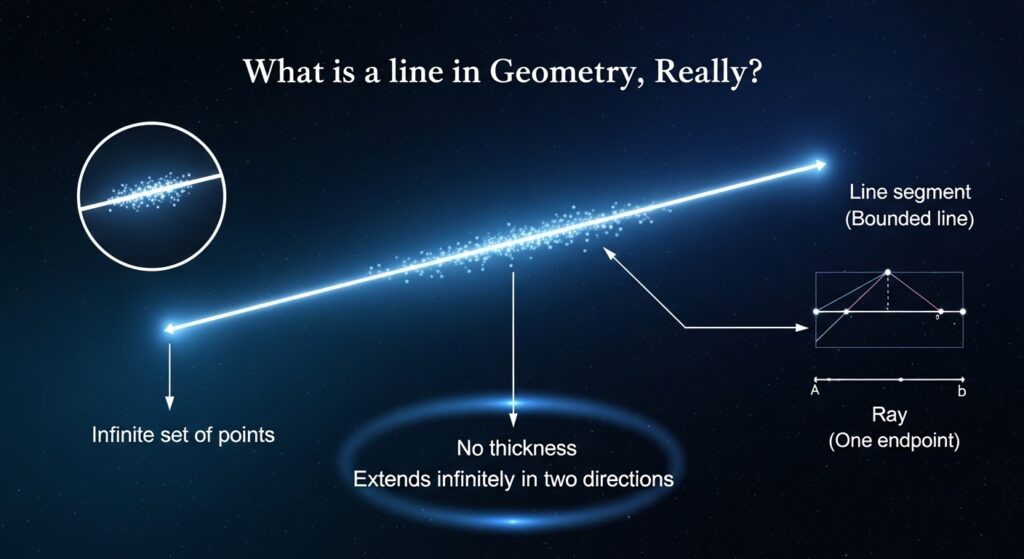
A Line (geometry) sounds simple until you say it out loud too many times. In basic terms, a line is a one-dimensional object. That means it has length, and only length. There is no width, no depth, just a thin idea stretching endlessly in two directions. It has no endpoints, no matter how badly your paper wants it to.
In Geometry basics, we say a line is made up of infinite Points, lined up so perfectly that they never drift apart. It lives inside Planes, crosses other lines at an intersection, and sometimes creates Angles when it meets others with a bit of attitude.
You’ll see lines everywhere:
- The edge of a table pretending it’s finite
- The side of a phone screen acting very line-like
- Railroad tracks that look parallel until your eyes get tired
- A lamppost cutting the air like a vertical line
A retired math tutor once said, “A line is confidence. It knows where it’s going, even if you don’t.” That’s stuck with me, oddly.
Types of Lines in Geometry: The Big Family Introduction
When people ask, “How many types of lines are there?”, the honest answer is: enough to keep worksheets busy for years. But the core line types show up again and again in learning geometry, from math for kids to late-night revision sessions.
Here’s the thing though, these aren’t just abstract things. They describe relationships. Who meets who, who never meets, who crosses at a right angle (90°) like they planned it.
We’ll explore them slowly, with examples that live on your desk, your street, your kitchen floor. That’s where Geometry concepts explained really stick.
Straight Lines and Curved Lines: The First Quiet Argument

This is where geometry starts choosing sides.
A Straight line is exactly what it sounds like. No bends, no drama, no emotional arc. It moves in one consistent direction, endlessly, with infinite length. Think of the side of a door, the edge of paper, or the hands of a clock frozen at six.
A Curved line, on the other hand, refuses to behave. It changes direction continuously. The rim of a cup, the edge of a soccer ball, or the curve of plates stacked wrong in the sink. It’s still a line, still one-dimensional, but with personality.
Examples you’ll recognize:
- The curve of a bridge arching over water
- A winding road in the hills
- The outline of a window with fancy taste
- A spiral notebook wire doing its thing
This straight vs curved lines debate shows up early in Geometry fundamentals, and kids usually get it faster than adults, funny enough.
Horizontal Lines and Vertical Lines: Gravity Has Opinions
Now we bring the body into it. Your sense of balance helps here.
A Horizontal line runs left to right, parallel to the ground. It matches the horizon, the edge of the floor, or the top of a TV mounted just right. These lines don’t rise or fall, they just… continue.
A Vertical line goes up and down, like it’s resisting gravity or maybe cooperating with it too much. Buildings, ladders, lampposts, and the sides of windows love this orientation.
Everyday examples:
- The stripes on graphing paper
- The frame of a door
- The sides of a phone screen
- A clock hand at twelve o’clock
People often ask, “Are all straight lines horizontal?” Nope. Straight lines can point anywhere, they’re flexible like that. Orientation doesn’t change their straight-ness, just their mood.
Types of Lines – Definition With Examples: Parallel Lines and Their Quiet Agreement
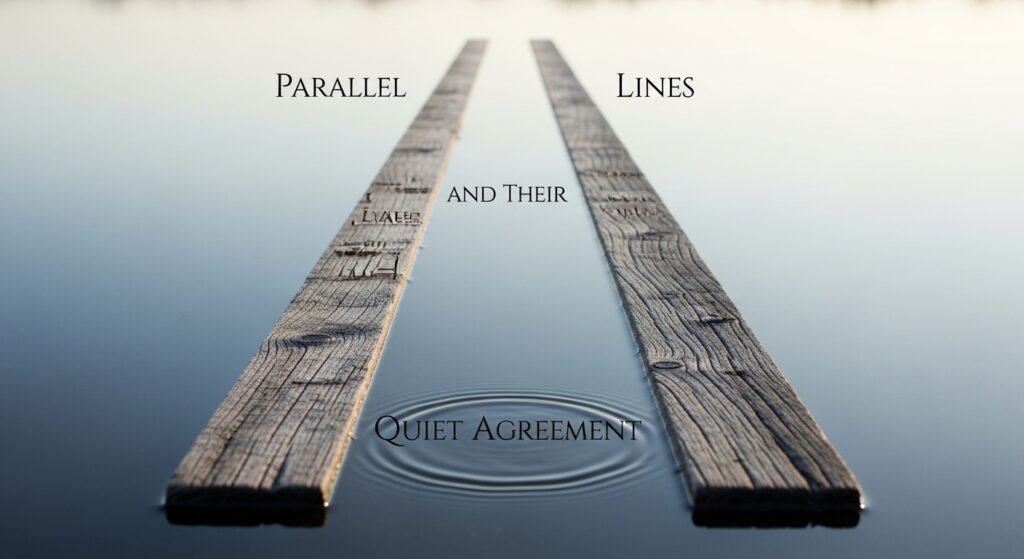
Parallel lines are the introverts of geometry. They live side by side, keep an equal distance, and promise never to meet. Not now, not ever. Even with infinite length, they respect the parallel relationship deeply.
Classic examples:
- Railroad tracks (until perspective messes with you)
- Lines on roads
- The rows on grids
- Shelves on a wall pretending to be aligned
In math language, they share the same slope, and the distance between lines stays constant. That’s the secret handshake.
A common FAQ pops up here: “Do parallel lines ever intersect?” In Euclidean geometry, nope. They’re loyal like that. In other geometries, things get weird, but that’s a different afternoon.
Intersecting and Perpendicular Lines: When Lines Actually Talk
When lines cross, something happens.
Intersecting lines meet at a point of intersection. That meeting creates angles, sometimes sharp, sometimes wide, sometimes awkward. Scissors mid-cut, road crossings, and the letter X all live here.
Perpendicular lines are a special case of intersecting lines. They meet at a perfect right angle (90°), clean and unapologetic. Think of:
- The corners of a table
- The edges of windows
- The squares on graphing paper
- A plus sign done properly
So, perpendicular vs intersecting lines? All perpendicular lines intersect, but not all intersecting lines are perpendicular. Geometry likes hierarchy, apparently.
Line Segment vs Ray vs Line: Same Family, Different Rules
This is where confusion sneaks in quietly.
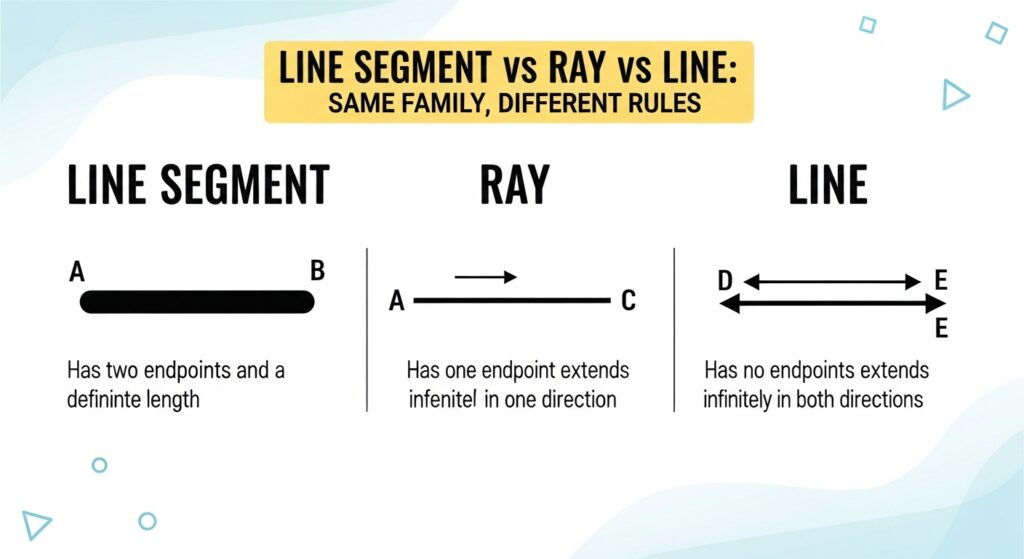
A Line segment has defined endpoints. It starts here, ends there, and that’s it. The side of a book, a pencil laid flat, or the edge of a phone screen.
A Ray has one start point and goes on forever in one direction. Like sunlight breaking through a window, or a laser pointer dot escaping your hand.
A Line, as we said, has no endpoints and goes forever in two directions.
Helpful comparisons:
- Line vs line segment: infinite vs finite
- Line vs ray: two directions vs one direction
- All are one-dimensional objects, just with different boundary rules
Teachers lean on this trio heavily in Math worksheets and practice problems, because once this clicks, a lot else does too.
Types of Lines in Geometry: Transversal Lines and the Art of Cutting Across
A Transversal line is a bit of a rebel. It crosses two or more lines, usually parallel lines, and creates a bunch of angles that geometry students are expected to name, measure, and not panic about.
You see transversals in:
- Road crossings
- Staircases cutting across building lines
- Bridges intersecting riverbanks
- Lines slicing through grids
This is where angle measurement becomes serious business. Alternate interior angles, corresponding angles, all that jazz. It’s also where Geometry practice problems get spicy.
Lines, Points, and Planes: The Quiet Foundation

Geometry doesn’t let lines live alone.
A Point has no size, just position.
A Line is made of infinite points.
A Plane is a flat surface extending infinitely in two dimensions.
Together, they form the backbone of Geometry fundamentals. You’ll see this trio in FAQs, in definitions, and plastered all over geometry worksheets meant to test patience more than knowledge.
A math educator once joked, “Points gossip, lines travel, planes host the party.” I don’t know if that’s official, but it helps.
Real Life Is Basically Lines Everywhere
Once you notice lines, you can’t unsee them.
- The crack in the floor
- The frame of windows
- The seams on roads
- The edges of tables
- The alignment of buildings
This is why geometry examples in real life matter. They ground the abstraction. Kids learn faster when they see math on their walk home, not just on a worksheet.
It’s also why math tutors often ask students to look around the room and name line types. Learning sticks better when it’s attached to a cup or a door you touched five minutes ago.
Why Lines Matter More Than You Think
So, why are lines important in geometry? Because everything else leans on them. Geometric shapes are just lines closing in on themselves. Angles are lines having opinions. Even complex graphs start with understanding the slope of a line.
In Math, lines teach direction, distance, and relationship. They show how things connect, or refuse to. In a quiet way, they teach logic, patience, and seeing patterns where chaos pretends to live.
Frequently Asked Questions
how many types of lines are there
There are 8 main types of lines in geometry, based on their shape, direction, and how they intersect with other lines.
how many types of lines
In mathematics, lines are mainly classified into eight types, such as straight, curved, parallel, perpendicular, and more.
रेखा किसे कहते हैं कितने प्रकार के होते हैं
रेखा ज्यामिति की एक एक-आयामी आकृति होती है जो दोनों दिशाओं में अनंत तक जाती है। रेखा के 8 मुख्य प्रकार होते हैं।
different types of line
The different types of lines are curved, straight, horizontal, vertical, parallel, intersecting, perpendicular, and transversal lines.
Read this Blog: https://marketmetl.com/how-big-is-50-feet/
Making Geometry Feel Personal (Yes, Really)
If you’re teaching, learning, or revisiting this stuff after years away, here’s how to make it stick:
- Draw lines on random paper, not just notebooks
- Use graphing paper to see order happen
- Relate every concept to an object near you
- Talk it out loud, even if it feels silly
And if you’re writing your own explanations, use your voice. Geometry doesn’t mind a little personality. It’s survived worse.
I’d love to hear how you first noticed lines, or which example finally made it click for you. Drop it in the comments, messy thoughts welcome.
Lines may be simple, but they carry worlds on their backs. And once you really see them, the world looks a little more connected, a little more intentional, even if still crooked in places. That’s geometry, doing its quiet work.