Someone once asked me, very casually, “hey, how long is 100 feet really?” and I nodded like I knew, like yes, of course, obviously, totally. Then I tried to picture it in my head and my imagination just… stopped.
Blank. Like a buffering wheel but for thoughts. I’ve walked distances, I’ve measured rooms, I’ve stood next to tall things and long things, but 100 feet as a concept floats around kinda slippery.
It’s not short-short, but it’s not wow that’s far either. It’s this in-between length that messes with your sense of scale, especially when you don’t carry a measuring tape (100-foot) around in your pocket, which most of us, shockingly, do not.
This is where distance visualization becomes your best friend, even if it’s a slightly unreliable one that exaggerates sometimes. Whether you’re in the United States, Canada, or anywhere else where people argue about Feet (ft) vs Meters, understanding a unit of measurement like this helps in real life more than we admit.
From construction sites to sports, from urban planning to someone saying “it’s only like 100 ft away,” these comparisons sneak into everyday convos. So let’s make it make sense, using things you’ve actually seen, stood next to, walked past while distracted.
| Comparison Object | How It Relates to 100 Feet |
|---|---|
| Basketball court | Almost the same length (court is ~94 feet) |
| Ten-story building | About the same height (≈10 feet per story) |
| School bus | Roughly 3 school buses end-to-end |
| American football field | About one-third of the field length |
| City block | Around one-third of a typical city block |
| Blue whale | Similar to the length of a full-grown blue whale |
| Wind turbine blade | Comparable to one large turbine blade |
| Boeing 737 | Close to the aircraft’s total length |
| Flagpole | Matches the height of many large flagpoles |
| Walking distance | About 30–40 normal steps |
Why Our Brains Struggle With a 100 Ft Measurement
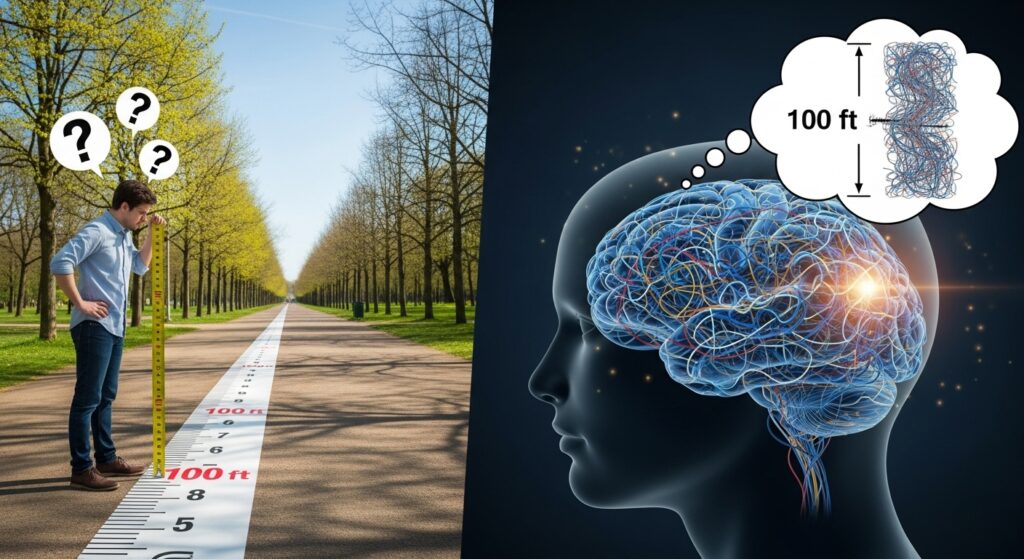
Before we start throwing objects at you, mentally speaking, it helps to know why 100 ft measurement feels weird. Humans are not great at abstract distance measurement unless it’s tied to movement, effort, or emotion. We get miles because road trips.
We get inches because fingers. But 100 feet sits awkwardly between a casual stroll and a meaningful walk, and our brains go “ehhh close enough.”
In engineering and architecture, 100 feet is clean, neat, and useful. In real life, it’s fuzzy. Ask someone to walk 30–40 steps and they’ll probably hit it, since the average stride length is about 2.5 feet per step, but nobody’s counting unless they’re bored or suspicious.
This is why length comparison matters. It anchors the number to reality, makes it sticky, like gum under a desk but educational.
What Does 100 Feet Look Like in Real Life? Classic Everyday Distances
This is where things get fun, and slightly chaotic. Below are some real-world size examples that help answer what does 100 feet look like without pulling out a calculator and crying softly.
- A basketball court is about 94 feet, which means 100 feet is just a tiny bit longer, like the court plus a dramatic leap at the end.
- Three school bus lengths almost nail it, since one bus is around 35 feet, give or take depending on vibes.
- A fire hose laid straight during firefighting operations often stretches close to this distance, which firefighters absolutely know and the rest of us kinda guess.
- Roughly the length of a large suburban backyard, the kind people swear is “huge” until they mow it twice.
- About the width of some smaller commercial spaces, especially older ones that weren’t designed with open concepts and influencer lighting.
- Close to the height of a tall flagpole, where flag raising and lowering suddenly feels like cardio.
- Just over the length of a standard IMAX theater screen, which is wild when you think about how small people look on those things.
Each of these hits different emotionally, and that’s the point. Visualizing distance isn’t about precision, it’s about recognition, like oh yeah, that long.
100 Feet Compared to Buildings and Structures That Loom Quietly
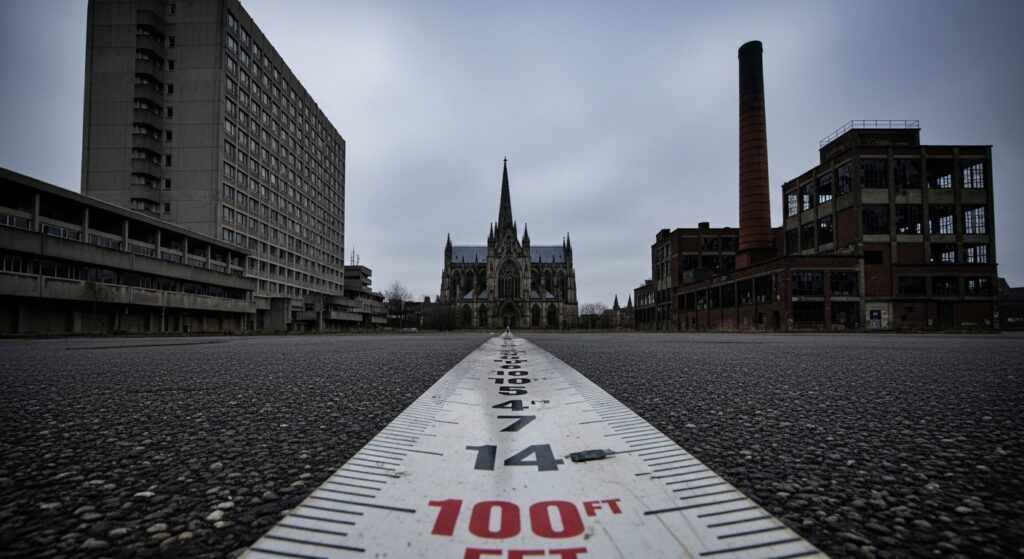
100 Feet and Buildings: A Height That Feels Serious
When you look up, 100 feet suddenly feels way more dramatic than when you look forward. Height messes with perception hard, and fast.
- A ten-story building is roughly 100 feet, assuming the rough rule of 10 feet per story, which architects use even though life is messier.
- Many residential apartments hit this height without ever announcing it, just quietly existing above your head.
- Some older radio towers in small towns sit right around this range, especially the ones birds argue over.
- In urban planning, 100-foot limits are common to preserve skylines, sunlight, and neighborly resentment.
- Eco-friendly building designs sometimes cap out here to balance density with energy-efficient systems.
- A tall church steeple, depending on era and enthusiasm, can flirt with this height too.
- Certain commercial spaces with stacked offices feel taller than they are, which is rude honestly.
Looking up 100 feet can make your neck hurt. Looking across it feels chill. Same number, wildly different vibe.
100 Feet in Sports, Where Distance Suddenly Has Feelings
100 Feet in Sports and Movement
Sports give distance context because your body gets involved, and bodies are dramatic.
- An American football field is 300 feet long, so 100 feet is one third of that, which feels manageable until you sprint it.
- In sports training drills, coaches often set cones 100 feet apart because it’s long enough to burn, short enough to repeat.
- A baseball outfield throw that travels 100 feet is respectable, not legendary, but you’ll hear a few “nice arm” comments.
- Indoor training facilities sometimes max out at this length, forcing athletes to do awkward turns.
- For swimmers, 100 feet is roughly two thirds of an Olympic pool length, which feels unfairly specific.
- In track warmups, a 100-foot stride drill feels short until your lungs disagree.
- Even casual walking, 100 feet takes about 30–40 steps, which you can test in your kitchen if you’re bored.
Movement makes how big is 100 feet in real life suddenly obvious, especially when you’re out of breath.
100 Feet and Nature: When Trees and Animals Enter the Chat

100 Feet in the Natural World
Nature does not care about your units, but it accidentally provides great length reference objects.
- A mature Oak tree (Northern Red Oak, White Oak) can reach close to 100 feet, quietly doing carbon sequestration while squirrels judge you.
- The length of a blue whale can approach this too, which is upsetting in the best way. They weigh about 200 tons and eat 4 tons of krill per day, like it’s nothing.
- Some wind turbine blades are around 100 feet long, spinning gently while contributing to renewable energy and bird anxiety.
- In dense wildlife habitat, 100 feet can be the difference between sunlight and moss.
- Birds often consider 100 feet a casual flight hop, which feels rude given how hard we find it.
- Certain coastal marine navigation markers use this height for visibility without being obnoxious.
- In forests, 100 feet of fallen log can become a tiny ecosystem for insects, which is kinda beautiful and gross.
Nature makes 100 feet feel both massive and normal, depending where you stand, or float.
100 Feet in Transportation and Big Machines That Don’t Care About You
100 Feet and Machines That Are Way Too Confident
When machines hit 100 feet, they do it with zero humility.
- A Boeing 737 is about 100 feet long, give or take the model and airline personality.
- Parts of an Airbus A380 absolutely dwarf this, which makes 100 feet feel suddenly small.
- A jet aircraft wing can span near this length, slicing air like it owns the place.
- Some cinema technology rigs, especially in older theaters, stretch close to this for projection setups.
- Industrial cranes in construction often extend booms past 100 feet without apology.
- Large ships use this measurement constantly in marine navigation, especially docking maneuvers.
- Fire control ladders on certain trucks can reach near this height, which is both comforting and alarming.
Big machines recalibrate your sense of scale real fast. Suddenly your house feels tiny.
Read this Blog: https://marketmetl.com/long-is-8-inches/
City Blocks, Streets, and Walking It Out
100 Feet vs a City Block (Spoiler: It’s Not Even Close)
People love saying “it’s like a block away,” but a city block is usually 300–400 feet, depending on the city and historical chaos. So 100 feet is more like a third of a block, the distance you walk while still deciding where you’re going.
- In older cities, blocks vary wildly, which makes distance benchmarks unreliable.
- In suburban layouts, 100 feet might be driveway to mailbox times ten.
- In dense downtowns, it’s the space between crosswalks that feel too close together.
- Urban planners think in these chunks constantly, especially for pedestrian flow.
- Walking distance of 100 feet feels trivial until you’re carrying groceries.
- Snow, rain, or heat can make it feel longer, emotionally speaking.
- At night, 100 feet can feel farther, which is a psychology thing and also a safety thing.
Context changes everything. Always has, always will.
Measurement Math Without the Headache
Let’s ground this with quick unit conversion, gently, no stress.
- 100 feet equals 1,200 Inches, which is ridiculous and unnecessary to picture.
- It’s about 33.3 Yards, which helps if you think in football fields.
- Roughly 30.48 Meters, which makes metric folks nod calmly.
- That’s 3,048 Centimeters, which nobody needs unless they’re building something tiny and precise.
- It’s 0.0189 Miles, which is basically nothing but technically something.
- In Kilometers, it’s 0.03048, which looks fake but isn’t.
These numbers matter in engineering and architecture, but for everyday life, comparisons win every time.
How to Actually Use 100 Feet as a Mental Tool

If you want real-life measurement to stick, tie 100 feet to something you do.
- Walk it once and remember the feel.
- Stand at one end of a basketball court and imagine a little extra.
- Look up at a ten-story building and lock that image in.
- Notice how long a fire hose runs when you see one deployed.
- Watch a plane taxi and clock its length.
- Use your steps as a reference, imperfect but useful.
- Teach kids using trees, buses, and screens, not numbers.
That’s how distance visualization stops being abstract and starts being intuitive.
Frequently Asked Questions
how much is 100 ft
100 feet is a distance measurement equal to 1,200 inches or about 30.48 meters. It is commonly used to measure height, length, or distance.
how big is 100 ft
100 ft is quite large and can be compared to the height of a ten-story building or the length of a basketball court. It helps visualize medium to large structures.
whats 100 feet
100 feet is a standard unit of length used mainly in the United States and Canada. It represents a measurable distance often used in construction and planning.
100ft example
Examples of 100 ft include a wind turbine blade, a tall flagpole, or three school buses placed end to end. These comparisons make the size easier to imagine.
100 feet is how many stories
100 feet is approximately equal to a 10-story building, assuming each story is about 10 feet high. This is a common architectural estimate.
Final Thoughts: Making Peace With 100 Feet
So, things that are 100 feet long aren’t rare, and they aren’t exotic, they’re just hiding in plain sight. From sports fields to renewable energy tech, from trees quietly cleaning the air to machines loudly ignoring gravity, this length shows up everywhere.
Understanding it isn’t about memorizing conversions or flexing math skills. It’s about recognizing scale, feeling distance, and being able to say “yeah, I get it” and actually mean it.
Next time someone asks how long is 100 feet, you won’t nod blindly. You’ll picture a building, a whale, a court, a tree. And your brain won’t buffer. It’ll just know, more or less, which is honestly good enough.
If you’ve got your own favorite 100 feet comparison examples, maybe from work, travel, or some oddly specific moment, share it. We’re all just borrowing references from each other anyway.